Evaluating E-Learning Platforms: 2026 Accessibility & Engagement

Advertisements
E-Learning Platforms are evolving rapidly across U.S. higher education in 2026, with artificial intelligence becoming more deeply integrated into assessment, course design, academic support, and student services. EDUCAUSE identifies AI as one of the major forces reshaping teaching and learning this year.
Digital learning infrastructure also remains central to access and flexibility, while federal education research continues examining how widely used learning platforms can improve instruction and educational research. New federal Workforce Pell Grants, available beginning July 1, 2026, are also expanding aid for eligible short-term workforce programs.
Institutions should monitor AI governance, academic integrity, student privacy, accessibility, and the effectiveness of digital learning tools as adoption expands. The next phase will depend on how colleges balance technological innovation with reliable assessment, inclusive access, and meaningful student engagement.
The Evolving Landscape of E-Learning Platforms in 2026
The year 2026 marks a pivotal moment for digital learning environments, with advancements in AI, virtual reality, and data analytics redefining educational delivery. Universities are actively seeking platforms that not only support diverse pedagogical approaches but also future-proof their educational offerings.
This ongoing shift demands a comprehensive understanding of what constitutes a truly effective and equitable e-learning solution. The focus has sharpened considerably on user experience, moving beyond basic functionality to nuanced aspects of interaction and support.
Consequently, the process of E-Learning Platforms requires a more rigorous framework. Decisions made now will significantly impact student success and institutional reputation for years to come, emphasizing the need for strategic foresight.
Defining Accessibility Standards for 2026

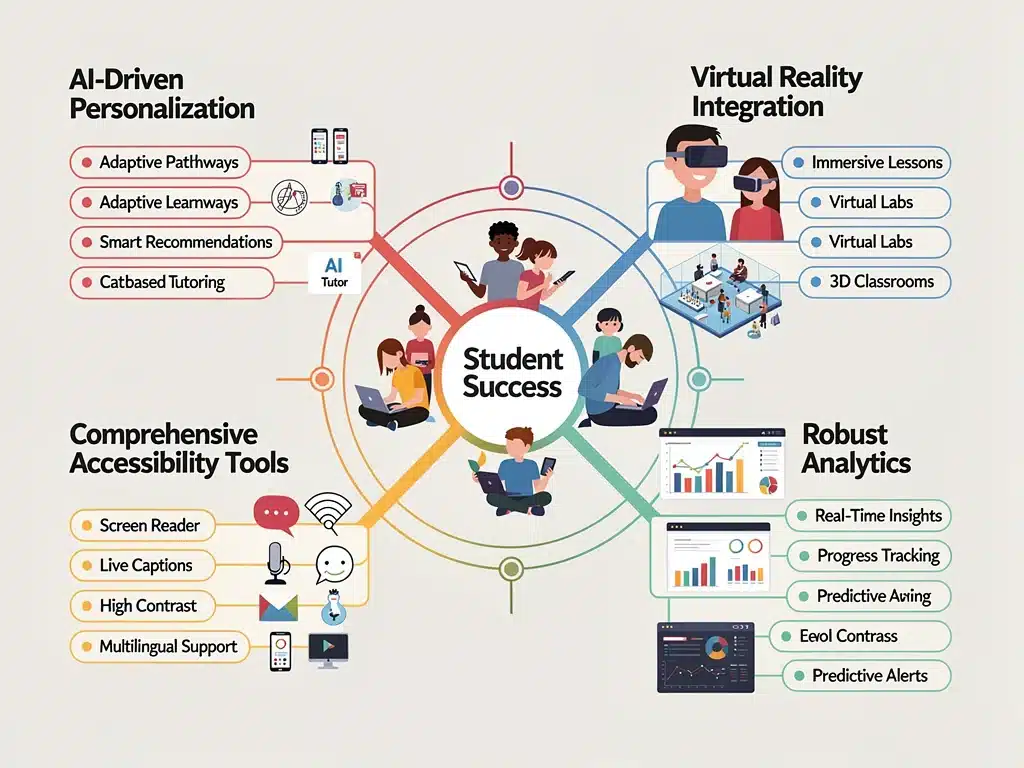
Accessibility in 2026 extends far beyond mere compliance with basic regulations like WCAG. It encompasses a holistic approach to design that ensures all students, regardless of ability, can fully participate and succeed in online learning.
Leading platforms are integrating advanced features such as AI-powered captioning, customizable interfaces, and robust keyboard navigation.
These elements are no longer optional but are becoming foundational requirements for any competitive e-learning platform 2026.
- Automated transcription and translation services for diverse linguistic needs.
- High-contrast themes and font customization options for visual impairments.
- Compatibility with a wide range of assistive technologies, including screen readers and voice control.
- Structured content and clear navigation paths to reduce cognitive load.
Enhancing Student Engagement Features
Engagement remains a cornerstone of effective online learning, and platforms in 2026 are leveraging sophisticated tools to foster active participation. Interactive content, collaborative spaces, and personalized learning paths are key differentiators.
Gamification elements, virtual labs, and simulated environments are increasingly common, transforming passive content consumption into dynamic, experiential learning. These features are crucial for maintaining student motivation and improving learning outcomes.
Moreover, real-time feedback mechanisms and adaptive assessments play a vital role in keeping students connected to their learning journey. Such tools provide immediate insights, allowing for timely interventions and adjustments to instructional strategies within an e-learning platform 2026.
The integration of social learning functionalities, such as discussion forums and peer review tools, also contributes significantly to engagement. These features replicate the communal aspects of traditional classroom settings, building a sense of community among remote learners.
Key Metrics for Evaluating E-Learning Platforms 2026
When undertaking the critical task of evaluating e-learning platforms 2026, institutions must consider a range of performance indicators. These metrics go beyond initial cost and focus on long-term value, user satisfaction, and educational impact.
Key metrics include platform uptime, response times for technical support, and the extensibility of the system through APIs for integration with other university systems. A robust platform must demonstrate reliability and seamless interoperability.
Furthermore, data analytics capabilities are paramount, offering insights into student performance, engagement patterns, and content effectiveness.
These insights enable continuous improvement of courses and targeted student support, making data a central component of any e-learning platform 2026 assessment.
User Experience and Interface Design
A highly intuitive and aesthetically pleasing user interface (UI) is non-negotiable for an effective e-learning platform in 2026. Students and faculty expect a seamless experience that reduces friction and allows them to focus on teaching and learning, not navigating complex systems.
Clean layouts, logical navigation, and responsive design across all devices are fundamental. Platforms that offer a personalized dashboard and customizable settings empower users to tailor their learning environment to individual preferences and needs, greatly enhancing user satisfaction with any e-learning platform 2026.
The ease of creating and managing content, alongside straightforward communication tools, directly impacts faculty adoption and efficiency. A positive user experience for educators translates directly into higher quality course delivery and student satisfaction.
Security and Data Privacy Considerations
With increasing cyber threats and stringent data protection regulations, the security framework of an e-learning platform 2026 is a critical evaluation criterion. Institutions must ensure student data is protected, and intellectual property is secure.
Platforms must adhere to international data privacy standards like GDPR and FERPA, implementing robust encryption, access controls, and regular security audits. Transparency in data handling practices is also essential for building trust with users.
- Multi-factor authentication (MFA) and granular access permissions.
- Regular penetration testing and vulnerability assessments.
- Compliance with industry-specific data protection regulations.
- Clear data retention policies and user consent mechanisms.
Comparative Analysis of Leading Platforms for 2026
A thorough comparative analysis is essential when evaluating e-learning platforms 2026. This involves assessing how different solutions stack up against evolving industry benchmarks and specific institutional requirements.
Leading platforms are distinguishing themselves through specialized features tailored to various educational models, from fully online programs to blended learning. Understanding these nuances is key to selecting the right fit for a college or university.
The comparison must extend beyond feature lists to examine vendor support, community resources, and the platform’s roadmap for future development. A platform’s longevity and adaptability are crucial for long-term strategic investment.
Platform A: Focus on Immersive Learning
Platform A has emerged as a frontrunner due to its exceptional capabilities in immersive learning experiences. It integrates seamlessly with VR/AR technologies, allowing for highly interactive simulations and virtual field trips.
Its engagement features include advanced gamification modules and AI-driven personalized feedback loops, which have shown to significantly boost student retention rates. However, its accessibility suite, while compliant, may require additional third-party integrations for advanced needs.
The platform’s strength lies in its ability to create highly dynamic and memorable learning environments. This makes it particularly attractive for disciplines that benefit from hands-on, experiential learning, such as engineering and healthcare.
Platform B: Accessibility as a Core Design Principle
Platform B stands out for its unwavering commitment to accessibility, embedding universal design principles into its core architecture. It offers a comprehensive suite of built-in tools that cater to a wide spectrum of disabilities.
Features such as adaptive text-to-speech, customizable color palettes, and robust keyboard navigation are standard, reducing the need for external assistive technologies. This makes it an ideal choice for institutions prioritizing inclusivity when evaluating e-learning platforms 2026.
While its engagement features are solid, they might not be as cutting-edge in terms of immersive technologies as Platform A. Nevertheless, its reliability and ease of use for all learners provide a strong foundation for broad adoption across diverse student populations.
The Impact of AI and Machine Learning on E-Learning
Artificial intelligence and machine learning are profoundly reshaping the capabilities of e-learning platforms, moving beyond simple automation to intelligent adaptation. These technologies are crucial for delivering personalized and efficient learning experiences in 2026.
AI-driven analytics can identify at-risk students, recommend tailored resources, and automate grading for certain assignment types, freeing up faculty time for more complex instructional tasks. This intelligent assistance enhances both student support and teaching effectiveness.
The integration of AI tutors and chatbots also provides instant support and answers to common queries, ensuring students receive timely assistance outside of traditional office hours. This continuous availability is a significant advantage for any e-learning platform 2026.
Personalized Learning Pathways
AI algorithms are enabling truly personalized learning pathways, adapting content and pace to individual student needs and learning styles. This ensures that each student receives the most effective instruction, maximizing their potential.
By analyzing performance data and engagement patterns, platforms can dynamically adjust the curriculum, offering remedial resources or advanced challenges as appropriate.
This level of customization was previously unattainable on a large scale, but now defines the leading e-learning platforms 2026.
- Adaptive assessments that adjust difficulty based on student responses.
- Content recommendations tailored to individual learning goals and progress.
- Automated feedback on assignments, identifying areas for improvement.
- AI-powered study guides and resource curation.
Automated Assessment and Feedback
The automation of assessment and feedback processes through AI is revolutionizing how educators evaluate student learning. This efficiency allows for more frequent and immediate feedback, which is critical for student development.
From automatically grading multiple-choice questions to providing nuanced feedback on written assignments using natural language processing, AI tools streamline administrative burdens.
This enables educators to focus on higher-order teaching activities, enhancing the overall quality of instruction within an e-learning platform 2026.
Furthermore, AI can detect potential academic integrity issues, providing an additional layer of security and fairness in online assessments. This capability is becoming increasingly sophisticated, offering robust solutions for maintaining academic standards.
Integration with Existing University Systems
The seamless integration of an e-learning platform with a university’s existing technological ecosystem is a non-negotiable requirement for 2026. Disjointed systems lead to inefficiencies, data silos, and frustration for both students and staff.
Key integrations include Student Information Systems (SIS), library databases, and administrative portals. A well-integrated platform ensures a unified user experience and accurate data flow across all institutional functions.
Platforms must offer robust APIs and adhere to industry standards for interoperability, allowing for flexible connections with various third-party applications. This ensures that the chosen e-learning platform 2026 can evolve with the university’s needs without extensive re-engineering.
Data Analytics and Reporting Capabilities
Advanced data analytics and reporting are vital for institutions to understand the effectiveness of their online programs and to identify areas for improvement. A comprehensive e-learning platform in 2026 provides actionable insights.
Dashboards should offer real-time data on student engagement, course completion rates, and learning outcomes.
These insights support evidence-based decision-making for curriculum development and student support services, making data a central pillar for evaluating e-learning platforms 2026.
- Granular data on student activity, including login times and resource access.
- Predictive analytics to identify students at risk of falling behind.
- Customizable reports for various stakeholders, from faculty to administrators.
- Integration with business intelligence tools for deeper analysis.
Future Trends and Considerations for E-Learning
Looking ahead, several emerging trends will continue to shape the development and adoption of e-learning platforms beyond 2026. Institutions must remain agile and forward-thinking in their technology investments to stay competitive.
The continued convergence of virtual and augmented reality with AI promises even more immersive and adaptive learning environments.
These innovations will push the boundaries of what is possible in digital education, impacting how we continue evaluating e-learning platforms 2026 and beyond.
Furthermore, the demand for micro-credentials and flexible learning pathways will necessitate platforms that can support diverse program structures and non-traditional learners. The future of e-learning is increasingly modular and personalized.
Micro-Credentials and Modular Learning
The rise of micro-credentials and modular learning is transforming how is delivered and consumed. Students are seeking flexible, bite-sized learning opportunities that can be stacked to achieve larger qualifications, and e-learning platforms 2026 must support this trend.
Platforms capable of managing and tracking individual modules, issuing verifiable digital badges, and integrating with professional development ecosystems will be highly valued. This shift caters to lifelong learners and those seeking to upskill rapidly in a changing job market.
The ability to offer personalized learning paths composed of various modules empowers students to tailor their education to specific career goals, making the learning process more relevant and efficient. This flexibility is a key consideration when evaluating e-learning platforms 2026.
Ethical AI in Education
As AI becomes more integral to e-learning, the ethical implications of its use are gaining significant attention. Ensuring fairness, transparency, and accountability in AI algorithms is paramount for maintaining trust and equity in education.
Platforms must develop and implement ethical guidelines for AI deployment, addressing concerns around data bias, algorithmic discrimination, and student privacy. This commitment to ethical AI will be a distinguishing factor for leading e-learning platforms in 2026.
- Transparent algorithms explaining AI-driven decisions.
- Robust data anonymization and privacy protocols.
- Regular audits for algorithmic bias and fairness.
- User control over data sharing and AI personalization settings.
| Key Aspect | 2026 Focus |
|---|---|
| Accessibility | Beyond compliance; inclusive design and assistive tech integration. |
| Engagement | Immersive experiences, gamification, and personalized interactions. |
| AI Integration | Adaptive learning, automated feedback, and ethical considerations. |
| Data & Security | Robust analytics, privacy compliance, and system interoperability. |
Frequently Asked Questions About E-Learning Platforms
Primary considerations include comprehensive WCAG compliance, built-in assistive technologies, customizable interfaces for diverse needs, and compatibility with external tools. Platforms must ensure all students, regardless of ability, can fully engage with content and functionalities, moving beyond basic requirements to truly inclusive design.
Student engagement is critically important as it directly impacts learning outcomes and retention. Platforms in 2026 should offer interactive content, gamification, collaborative tools, and personalized feedback. These features transform passive learning into dynamic experiences, fostering active participation and a sense of community among students.
AI plays a transformative role by enabling personalized learning paths, adaptive assessments, and automated feedback. It helps identify at-risk students, recommends tailored resources, and streamlines administrative tasks. Ethical AI deployment, ensuring fairness and transparency, is also a growing concern for e-learning platforms 2026.
Key requirements include adherence to international data privacy standards like GDPR and FERPA, robust encryption, multi-factor authentication, and regular security audits. Platforms must ensure student data is protected, intellectual property is secure, and transparent data handling practices are in place to build user trust.
Seamless integration with systems like SIS and library databases prevents data silos and inefficiencies. It ensures a unified user experience and accurate data flow across institutional functions. Robust APIs and adherence to interoperability standards allow platforms to adapt and evolve with the university’s changing technological landscape.
Looking Ahead: Strategic Imperatives for E-Learning in 2026
The detailed analysis involved in evaluating e-learning platforms 2026 underscores a clear strategic imperative for higher education institutions: invest in solutions that prioritize both advanced accessibility and dynamic engagement. The landscape is moving rapidly towards intelligent, adaptive, and inclusive learning environments.
Colleges and universities must look beyond immediate needs to consider long-term scalability, ethical AI integration, and robust data security. The decisions made regarding e-learning platforms now will directly influence student success and institutional relevance in the coming years.
Monitoring emerging technologies and maintaining a flexible approach to platform adoption will be crucial. The goal is to create digital learning ecosystems that serve all students effectively, preparing them for a future that demands adaptable and technologically fluent individuals.