Cut Auto Loan Interest 2.5% with Refinancing in 60 Days
Advertisements
Auto loan interest refinancing can reduce borrowing costs when a new lender offers a lower APR than the one attached to your current vehicle loan.
The potential savings depend on your credit profile, remaining balance, vehicle value, loan term, fees, and the rates available when you apply.
A structured refinancing process can help borrowers compare offers efficiently without assuming a specific rate reduction or approval timeline.
Understanding Auto Loan Refinancing
Refinancing replaces an existing vehicle loan with a new loan that pays off the remaining balance owed to the current lender.
Borrowers usually refinance to obtain a lower APR, change the repayment term, reduce the monthly payment, or adjust other loan conditions.
The transaction is worthwhile only when the benefits of the new agreement exceed any fees, longer repayment period, or other additional costs.
How a Lower Rate Can Reduce Costs
A lower interest rate generally reduces the amount charged for borrowing money when the balance and repayment period remain comparable.
The actual savings depend on how much principal remains and how long the borrower will continue making payments under the new agreement.
Extending the term can reduce the monthly payment while potentially increasing total interest, so both monthly and lifetime costs should be compared.
Check Your Current Loan Before Refinancing
Before shopping for a new loan, review the current APR, balance, monthly payment, remaining term, and payoff amount.
The payoff balance may differ from the amount shown on a monthly statement because interest and other contract terms can affect it.
Understanding the existing loan creates a baseline that allows new refinancing offers to be compared accurately rather than by payment alone.
Look for Prepayment Penalties and Fees
Some auto loan contracts can include a prepayment penalty that becomes relevant when refinancing pays the existing loan off early.
Whether a penalty can apply depends on the contract and state law, making it important to review the existing agreement first.
Refinancing fees should also be included in the savings calculation because upfront charges can reduce the financial benefit of a lower rate.
Review Your Credit Profile
Lenders commonly consider credit scores and history when determining the rate and terms they are willing to offer.
Income, debts, loan amount and repayment term can also influence the final offer rather than credit score acting as the only factor.
If your financial profile has improved since obtaining the original loan, refinancing may provide access to more competitive terms.
Check Credit Reports for Errors
Reviewing credit reports before submitting applications can help identify inaccurate information that might affect lending decisions.
Legitimate errors can be disputed with the appropriate credit reporting company, although removing accurate negative information is not guaranteed.
A corrected report may improve how lenders evaluate the application when the inaccurate information was materially affecting the borrower's profile.
Review reports from Equifax, Experian, and TransUnion.
Check payment histories and account balances for inaccuracies.
Dispute legitimate errors using the appropriate process.
Avoid services promising guaranteed or immediate credit-score increases.
Improve Credit Before Applying When Possible
Consistent on-time payments and lower revolving balances can contribute to a healthier credit profile over time.
Avoiding unnecessary new debt shortly before refinancing may also help keep the application from becoming more complicated.
Credit improvement has no guaranteed timetable, so borrowers should evaluate actual offers instead of assuming a particular score increase.
Understand Vehicle Value and Loan-to-Value
The vehicle itself matters because it serves as collateral for the new loan and lenders evaluate how much is owed relative to its value.
This relationship is commonly expressed as the loan-to-value ratio, or LTV, which compares the loan balance with the vehicle's value.
A high LTV can make refinancing more difficult because the lender may be assuming greater risk on the transaction.
When You Owe More Than the Car Is Worth
A borrower is considered underwater when the outstanding loan balance exceeds the current value of the vehicle.
Some lenders may decline these applications or limit how much negative equity they are willing to refinance.
Reducing the balance before applying can improve the LTV, although doing so should still fit within the borrower's broader budget.
Shop Multiple Lenders
Comparing lenders is one of the most important steps in auto loan interest refinancing because offers can vary for the same borrower.
Banks, credit unions and online lenders may use different underwriting models, eligibility requirements, rates and fee structures.
The CFPB recommends comparing several offers because lenders are not required to automatically provide the lowest rate available to you.
Prequalification Versus Formal Applications
Some lenders offer prequalification using a soft credit inquiry that provides estimated terms without the same effect as a hard application inquiry.
A prequalified offer is not final because the lender still needs to verify information before issuing actual approval terms.
Borrowers should confirm whether a lender uses a soft or hard inquiry rather than assuming every prequalification process works identically.
Compare banks, credit unions, and online lenders.
Check whether prequalification uses a soft credit inquiry.
Compare APR rather than advertised interest rate alone.
Review fees and repayment terms with each offer.
Compare APR Instead of Interest Rate Alone
The interest rate represents the cost charged for borrowing, while the APR incorporates the interest rate plus certain loan fees.
That makes APR a more useful comparison tool when two lenders advertise similar rates but charge different financing costs.
Borrowers should compare APR with APR and confirm that the repayment terms being evaluated are reasonably similar.
Calculate the Total Cost of Each Offer
A lower monthly payment does not necessarily indicate a cheaper loan because extending repayment can produce more interest over time.
Compare the total amount expected to be paid, remaining term, fees and monthly obligation before accepting a refinance offer.
This prevents a payment reduction from being mistaken for genuine savings when the loan simply remains outstanding for several additional years.
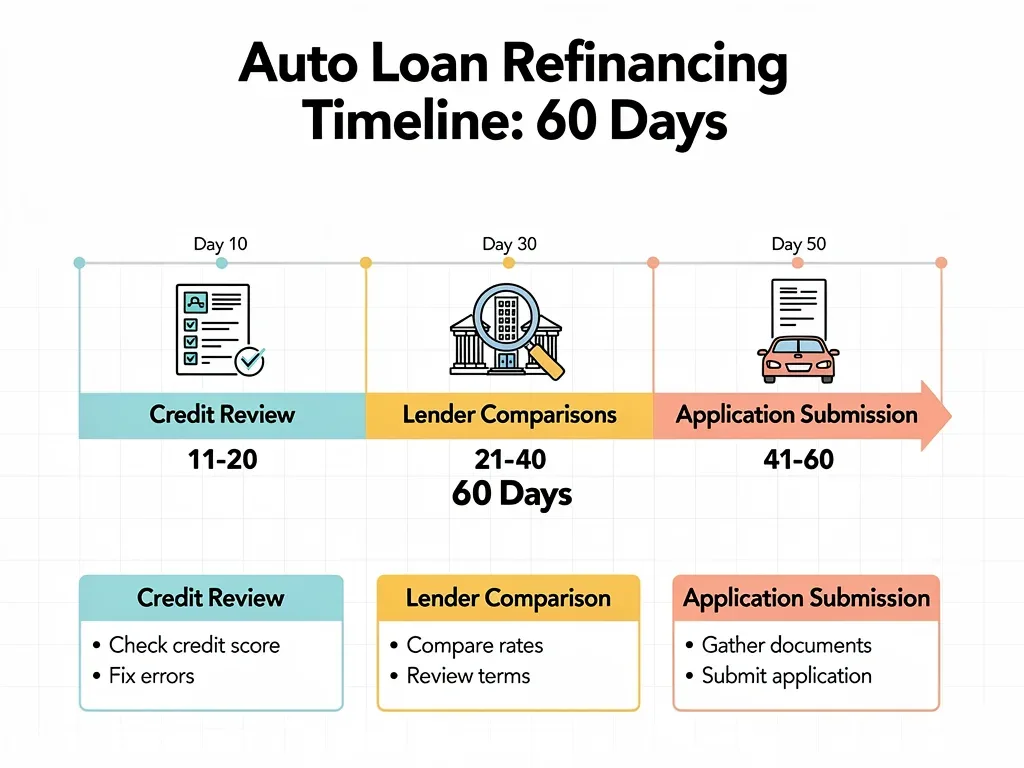
A Practical Refinancing Timeline
Refinancing can sometimes be completed relatively quickly, but there is no universal requirement that the process finish within 60 days.
Timing depends on documentation, lender underwriting, title requirements, state procedures and how quickly information is supplied and verified.
A structured process can still help borrowers avoid unnecessary delays and compare available options without rushing into unfavorable terms.
Phase One: Preparation and Research
Begin by collecting the payoff information, existing contract, insurance information, vehicle details, identification and proof of income.
Then research lenders and identify those whose vehicle-age, mileage and loan-balance requirements match the current situation.
Prequalification can help narrow the list before borrowers submit formal applications requiring more complete underwriting.
Obtain the current payoff amount.
Review the existing loan agreement.
Gather proof of income and vehicle information.
Research refinancing eligibility before formally applying.
Phase Two: Applications and Comparison
Once a shortlist is established, submit applications close together and compare the actual terms each lender provides.
The CFPB notes that multiple auto-loan credit inquiries made within a rate-shopping window are generally treated differently from unrelated applications.
Credit-scoring models vary, so borrowers should complete rate shopping within a relatively concentrated period whenever practical.
Evaluating the Final Loan Offer
A refinancing approval should be reviewed carefully before signing because the final terms may differ from preliminary estimates.
Confirm APR, payment amount, repayment length, fees, payment due date and whether any optional products have been added.
The loan should support the borrower's financial goals rather than simply replacing the old contract with another long obligation.
Questions to Ask Before Signing
Ask whether any origination, title, application or other financing fees apply and whether those charges are financed into the new balance.
Confirm whether the loan contains a prepayment penalty and whether additional principal payments can be made without unexpected restrictions.
Finally, determine exactly how the previous lender will be paid and what steps remain for transferring the vehicle title or lien.
Completing the Refinance
After the new loan closes, the refinancing lender typically sends funds to satisfy the remaining balance on the previous loan.
Borrowers should continue monitoring the old account until they have confirmation that the payoff was processed completely.
Any remaining payment or account issue should be addressed promptly to prevent late-payment reporting caused by assuming the payoff was already complete.
Verify the Old Loan Is Closed
Check the previous lender's account after refinancing and confirm that the loan shows a zero balance or appropriate payoff status.
Keep copies of the new agreement and payoff documentation in case questions arise regarding the lien or account reporting.
Also confirm when the first payment on the new loan is due so the refinancing process does not create an accidental missed payment.
How Much Could Refinancing Save?
Potential savings depend on the remaining principal, new APR, remaining term, refinancing fees and how the repayment schedule changes.
A reduction of 2.5 percentage points could produce meaningful savings in some cases, but it is not a universal refinancing outcome.
The most useful analysis compares the actual current loan with the specific new offer rather than relying on a predetermined percentage target.
Example of a Rate Reduction
Suppose a borrower receives a refinancing offer several percentage points below the APR on the current loan with a similar remaining term.
That lower rate may reduce both the monthly payment and total remaining interest when fees do not offset the benefit.
If the new loan extends repayment significantly, however, total interest should still be calculated before concluding that the refinance saves money.
Strategies After Refinancing
After refinancing, borrowers who have additional room in their budgets may consider paying more than the required monthly amount.
Additional principal payments can reduce the balance faster when the loan terms permit them without penalties or other restrictions.
The appropriate strategy depends on emergency savings, higher-interest debt and other financial priorities rather than the auto loan in isolation.
Making Additional Principal Payments
Before sending extra money, confirm how the lender applies payments because servicing practices can differ between financial institutions.
When permitted, directing additional funds to principal reduces the balance on which future interest charges are calculated.
Borrowers should retain sufficient cash reserves rather than aggressively paying down the vehicle loan at the expense of essential emergency savings.
When Refinancing May Not Be Worthwhile
Refinancing is not automatically beneficial simply because another lender offers a lower monthly payment or slightly lower rate.
A small remaining balance, short remaining term or significant fees can reduce the financial advantage of replacing the existing agreement.
Vehicle age, mileage and negative equity can also limit available offers or make the new terms less attractive.
Watch for Longer Loan Terms
Extending the repayment period can lower the monthly payment while keeping the borrower in debt for considerably longer.
This can increase total interest even if the new rate appears more attractive than the rate on the current loan.
Compare the remaining total cost under the original contract with the projected total cost of the refinance before deciding.
Market Conditions and Auto Loan Rates
General interest-rate conditions influence consumer lending, but lenders do not simply price every auto loan directly from one Federal Reserve rate.
Individual offers also reflect borrower credit, income, debt, loan size, vehicle value and the lender's own underwriting standards.
Monitoring the broader rate environment can provide useful context, but actual refinancing quotes remain the most relevant comparison.
Economic Indicators Provide Context, Not Guarantees
Federal Reserve policy can influence borrowing conditions throughout the economy, but changes do not translate mechanically into identical auto loan reductions.
Inflation, credit conditions and lender competition can also affect the rates available in the consumer auto lending market.
Borrowers should therefore avoid delaying a clearly favorable offer solely because they expect a particular future policy decision.

Key Action | Why It Matters |
|---|---|
Review Current Loan | Creates an accurate baseline for comparing refinancing offers. |
Check Credit | Identifies factors that may affect available rates and terms. |
Compare Lenders | Helps identify competitive APRs, fees, and repayment terms. |
Review Total Cost | Prevents a lower payment from hiding a more expensive loan. |
Verify Payoff | Confirms that the original loan was properly satisfied. |
Frequently Asked Questions About Auto Loan Refinancing
Can refinancing lower my auto loan interest rate?
Yes, it may lower your rate when your financial profile or available market offers are better than when the original loan was issued.
Can I guarantee a 2.5-percentage-point reduction?
No. The rate offered depends on borrower, vehicle and lender factors, so no particular reduction can be guaranteed in advance.
Can auto loan refinancing be completed within 60 days?
It often can, but timing varies by lender, documentation, underwriting and title processing, so 60 days should not be treated as a guarantee.
Should I compare interest rates or APRs?
APR is generally more useful because it reflects the interest rate plus certain loan fees, allowing more complete comparisons between offers.
Can I refinance if I owe more than the car is worth?
Possibly, but high loan-to-value can limit lender options and may prevent some institutions from approving the requested refinance amount.
Can extending the loan reduce my monthly payment?
Yes, but a longer repayment term can increase total interest, so the lower monthly payment should be evaluated alongside lifetime cost.
What This Means
Auto loan interest refinancing can lower borrowing costs, but the outcome depends on receiving a genuinely better loan rather than hitting a fixed target.
Reviewing credit, comparing multiple lenders and analyzing APR, fees and total repayment costs provides a more reliable path to evaluating savings.
Borrowers who focus on the complete financial picture can decide whether refinancing improves both their monthly budget and long-term loan cost.