Navigating 2026 Digital AP Exam Shift: Boost Scores by 22%
Advertisements

Navigating digital AP exams in 2026 requires students to understand both the testing format and the study methods that are most strongly supported by learning research.
College Board administered 28 AP exams digitally in 2026, including fully digital and hybrid digital formats, while other AP assessments continued through different testing modes.
Evidence supports strategies such as retrieval practice, spaced study, targeted practice, and familiarity with the testing platform, but no credible evidence guarantees a 22% increase in AP scores of 4 or 5.
Understanding the 2026 Digital AP Exam Landscape
The 2026 AP testing system used several different administration formats rather than one universal fully digital model.
According to College Board's 2025–26 AP Coordinator's Manual, 28 AP exams were delivered digitally through Bluebook, with 16 fully digital exams and 12 hybrid digital exams.
Other AP subjects continued to use portfolio, language, performance, or other administration formats outside the standard Bluebook model.
Fully Digital Versus Hybrid Digital Exams
On fully digital AP exams, students complete both multiple-choice and free-response questions inside the Bluebook testing application.
On hybrid digital exams, students complete multiple-choice questions and view free-response prompts in Bluebook but handwrite their free-response answers in paper booklets.
This distinction matters because preparation for a hybrid Calculus or Physics exam may look different from preparation for a fully digital History or English exam.
What Students Should Check First
Students should verify the administration mode for their specific AP subject rather than assuming every exam works the same way.
College Board provides course-specific exam pages with information about structure, timing, calculators, reference materials, and digital requirements.
Knowing the format early makes it easier to practice the same response method that will be used on exam day.
Study Habit 1: Use Active Recall Instead of Passive Review
Active recall requires students to retrieve information from memory instead of repeatedly rereading notes or highlighting textbooks.
Research on learning consistently finds that practice testing and retrieval can improve long-term retention compared with passive review alone.
For AP preparation, this can mean answering questions from memory, recreating outlines, solving problems without notes, or explaining a concept before checking the source.

Implementing Active Recall Strategies
After finishing a chapter or lesson, convert key concepts into questions and try answering them without looking at the material.
Flashcards can also support retrieval practice when they require genuine recall rather than simple recognition of familiar wording.
For subjects with written responses, students should practice producing complete explanations, arguments, calculations, or evidence from memory.
Use Feedback After Retrieval
Retrieval practice becomes more useful when students check their answers and correct misunderstandings afterward.
Feedback helps distinguish between information that was genuinely mastered and answers that were incomplete, imprecise, or based on guessing.
A practical routine is to answer first, check second, record the error, and then attempt the same concept again later.
Study Habit 2: Space Study Sessions Across Time
Spaced practice means returning to material across multiple sessions instead of concentrating nearly all studying immediately before the exam.
Research has repeatedly linked distributed practice with stronger long-term retention, although the ideal spacing schedule depends on the material and retention interval.
For AP courses covering an entire academic year, this makes spacing particularly useful because students must retain material learned months before the May exam.
Spaced Repetition in Practice
Students can revisit earlier units every week while continuing to learn new material rather than waiting until the final review period.
A calendar, flashcard system, or simple spreadsheet can be used to schedule recurring reviews of topics that have not been practiced recently.
The exact intervals do not need to follow a rigid formula, because research does not show that one universal expanding schedule is always superior.
Review older material regularly throughout the course.
Spend more time on concepts that are difficult to retrieve.
Reduce unnecessary repetition of material already mastered.
Return to missed questions after enough time has passed to require retrieval again.
Combining Active Recall and Spaced Practice
Retrieval and spacing are often most useful when combined rather than treated as competing study methods.
A student might answer questions from an earlier AP unit without notes, check the answers, and then schedule another retrieval attempt several days later.
This creates repeated opportunities to strengthen access to knowledge instead of merely increasing familiarity with the textbook or notes.
Why This Combination Is Useful
Retrieval reveals what a student can actually produce from memory, while spacing makes that retrieval more demanding over time.
Research supports both approaches for durable learning across a variety of educational settings.
However, their benefits should be described as improvements in learning and retention rather than as a guaranteed increase in a particular AP score.
Study Habit 3: Practice Deliberately With AP-Style Questions
Practice is most valuable when students identify specific weaknesses and work deliberately to improve them.
Simply completing large numbers of questions without reviewing mistakes can reinforce the same misunderstandings or inefficient habits.
Students should use results from practice sets to decide which content areas, skills, or question types deserve additional attention.
Use Official AP Practice Materials
College Board provides course-specific practice resources, including released free-response questions, scoring guidelines, sample responses, and Bluebook test previews.
These materials are particularly valuable because they reflect the structure and expectations of the actual AP program.
Students can compare their work with scoring information to better understand what earns credit on written responses.
Analyze Mistakes Instead of Only Counting Them
After each practice session, classify mistakes as content gaps, reasoning errors, misread questions, calculation problems, or time-management issues.
Different causes require different solutions, so a student who lacks knowledge should respond differently from one who understands the concept but mismanages time.
Maintaining a short error log can make recurring problems visible and help guide the next study session.
Identify the exact reason for each important mistake.
Redo missed questions without looking at the original solution.
Practice similar questions until the underlying skill improves.
Revisit the same weakness later to check whether learning lasted.
Study Habit 4: Practice in the Actual Digital Environment
Content knowledge remains central, but familiarity with Bluebook can reduce unnecessary uncertainty during digital AP exams.
College Board allows students to access test previews in Bluebook so they can explore the interface and available tools before exam day.
This practice should complement academic preparation rather than replace it.
Mastering Bluebook Before Exam Day
Students should learn how to move through questions, enter responses, use available tools, and understand how their specific AP exam is administered.
For hybrid exams, they should also practice switching between reading prompts on screen and writing free-response answers by hand.
College Board's official test previews are preferable to guessing how the interface will behave based on unrelated online testing platforms.
Know Which Tools Your Subject Uses
Calculator access, reference materials, scratch paper, and response methods vary across AP subjects.
Students should review their individual course's exam information before deciding how to simulate the test at home.
Practicing with the wrong tools or response format can create habits that do not match the actual exam.
Internet Connection and Technical Readiness
The original article suggested that students should simply ensure they have a stable internet connection during the exam, but school-based AP administration is more structured than that.
Schools and AP coordinators prepare testing devices, Bluebook, room assignments, and Test Day Toolkit before the exam administration.
Students should follow their school's device and readiness instructions rather than independently redesigning the testing environment.
What Students Can Control
Students should make sure the required Bluebook application is installed and updated on the testing device when the school instructs them to do so.
Opening Bluebook and completing a test preview in advance can reveal interface questions before the actual exam.
Any accommodation, device, or accessibility issue should be raised with the school well before test day.
Using Personalized Feedback and Performance Data
Performance data can help students decide where additional study time will have the greatest value.
Practice scores should be broken down by topic, skill, response type, and mistake pattern instead of being viewed only as one overall percentage.
This turns practice into a diagnostic tool rather than simply another test.
Building a Simple Feedback Loop
Begin with a practice set, identify the weakest areas, review those concepts, and then test them again after a delay.
If performance improves, the student can reduce the amount of time devoted to that topic and shift attention to another weakness.
If the same error continues, the student may need a different explanation, teacher feedback, or more foundational review.
Collaborative Learning Can Support Individual Study
Studying with classmates can be useful when collaboration requires students to explain reasoning rather than simply divide the workload.
Teaching a concept, debating an interpretation, or comparing free-response approaches can reveal gaps that private rereading may not expose.
Group sessions work best when they have a clear objective and remain focused on course content rather than becoming general social study time.
Effective Digital Collaboration
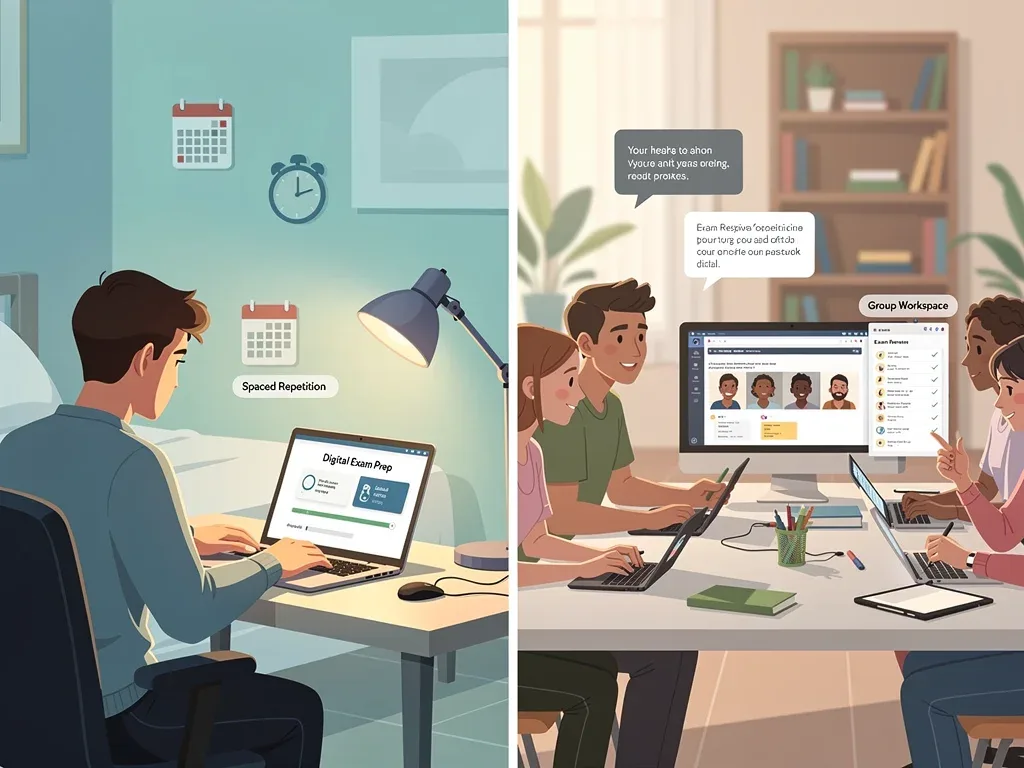
Students can use shared documents or video meetings to compare solutions, discuss difficult questions, or review scoring guidelines.
Each participant can prepare one topic and teach it to the group, followed by questions that require explanation from memory.
Collaborative study should supplement individual retrieval practice because each student ultimately takes the AP exam independently.
Set one or two specific goals for each session.
Explain answers rather than simply sharing them.
Use official scoring criteria when reviewing free responses.
End with individual questions to confirm personal understanding.
Sleep, Breaks, and Sustainable Preparation
Long study sessions are not automatically more productive, especially when fatigue reduces attention and accuracy.
Students can structure preparation around manageable sessions with breaks, regular sleep, meals, and normal physical activity.
These habits do not guarantee higher AP scores, but they can support concentration and make a long preparation schedule more sustainable.
Avoid Last-Minute Cramming as the Main Strategy
Cramming can create temporary familiarity with material but is less suited to retaining a year-long curriculum over extended periods.
Spacing study across weeks gives students more opportunities to discover forgotten material while there is still time to relearn it.
The final days before the exam are therefore better used for targeted review than for attempting to learn the entire course again.
The 22% Score-Rate Claim Is Not Supported
There is strong research support for retrieval practice and distributed practice, but that evidence should not be converted into an unsupported claim about AP score rates.
I found no College Board study or peer-reviewed AP-specific research demonstrating that these four habits increase the probability of earning a 4 or 5 by exactly 22%.
A more accurate claim is that these strategies can improve learning, retention, diagnostic practice, and familiarity with the exam environment.
Why Precise Performance Claims Need Direct Evidence
An AP score depends on subject knowledge, question difficulty, scoring standards, preparation, prior achievement, and many other factors.
A study showing improved recall in another educational context cannot automatically establish a specific increase in AP scores.
Students should use evidence-based strategies because they support learning, not because of a guaranteed percentage attached to them.
What Changed in the 2026 AP Administration
The 2026 administration largely continued the digital structure introduced in the previous exam cycle rather than representing an entirely new universal transition.
College Board's coordinator guidance stated that AP exams would be administered in the same general way as in 2025, including the combination of fully digital and hybrid digital exams.
Students preparing for 2026 therefore benefited from knowing which format applied specifically to their course.
Examples of Hybrid Digital Subjects in 2026
Subjects such as AP Biology, Calculus AB, Calculus BC, Chemistry, Macroeconomics, Microeconomics, Physics, and Precalculus used hybrid digital administration.
Students viewed digital content in Bluebook while completing designated free-response work on paper.
This is an important distinction from fully digital subjects in which all responses were entered and submitted through Bluebook.
Official Practice Resources Matter Most
Third-party apps and websites can supplement preparation, but official materials provide the closest representation of actual AP expectations.
College Board recommends using course exam pages, past free-response questions, scoring guidelines, student samples, and Bluebook test previews.
These materials allow students to practice both subject knowledge and the specific response format used by their exam.
How to Build a Practice Routine
Choose one official question set, complete it under realistic conditions, and score it using the published criteria where available.
Then identify the errors, review the relevant content, and repeat similar practice after a delay.
This combines retrieval, feedback, spacing, and deliberate practice within one repeatable routine.
Key Study Habit | Evidence-Based Benefit |
|---|---|
Active Recall | Strengthens retrieval and can improve long-term retention. |
Spaced Practice | Distributes learning over time instead of relying on massed review. |
Deliberate Practice | Targets specific weaknesses and uses feedback to guide improvement. |
Bluebook Practice | Builds familiarity with the actual digital testing environment. |
Frequently Asked Questions About Digital AP Exams
Were all AP exams fully digital in 2026? ▼
No. College Board reported 16 fully digital exams and 12 hybrid digital exams in 2026, while other AP assessments used different administration formats.
What is a hybrid digital AP exam? ▼
Students use Bluebook for multiple-choice questions and to view free-response prompts, but they handwrite their free-response answers in paper booklets.
Do these four study habits increase 4-and-5 score rates by 22%? ▼
No reliable AP-specific evidence supports that exact figure. The methods can improve learning and preparation, but a 22% score-rate increase should not be guaranteed.
How can active recall help with AP preparation? ▼
It requires students to retrieve knowledge without looking at notes, which research associates with stronger long-term retention than passive review alone.
Is spaced repetition useful for every AP subject? ▼
The general principle can support retention across subjects, but the specific practice activities should match the skills and content tested in each course.
Where should students practice the digital interface? ▼
College Board provides Bluebook test previews for digital AP exams, along with course-specific exam preparation materials and released questions.
Looking Ahead: Preparing for Future AP Exams
The move toward digital AP testing is continuing, but the format remains subject-specific and should not be described as one identical fully digital exam system.
College Board has already announced additional changes for 2027, including fully digital world language exams and a fully digital AP Statistics exam.
Students should therefore check current College Board guidance each year while continuing to rely on durable learning strategies such as retrieval, spacing, feedback, and realistic practice.
Explore accessibility and engagement in e-learning platforms Read more about online learning platforms