High-Yield Savings Accounts Over 4.25%: Park Your Cash in 2026
Advertisements
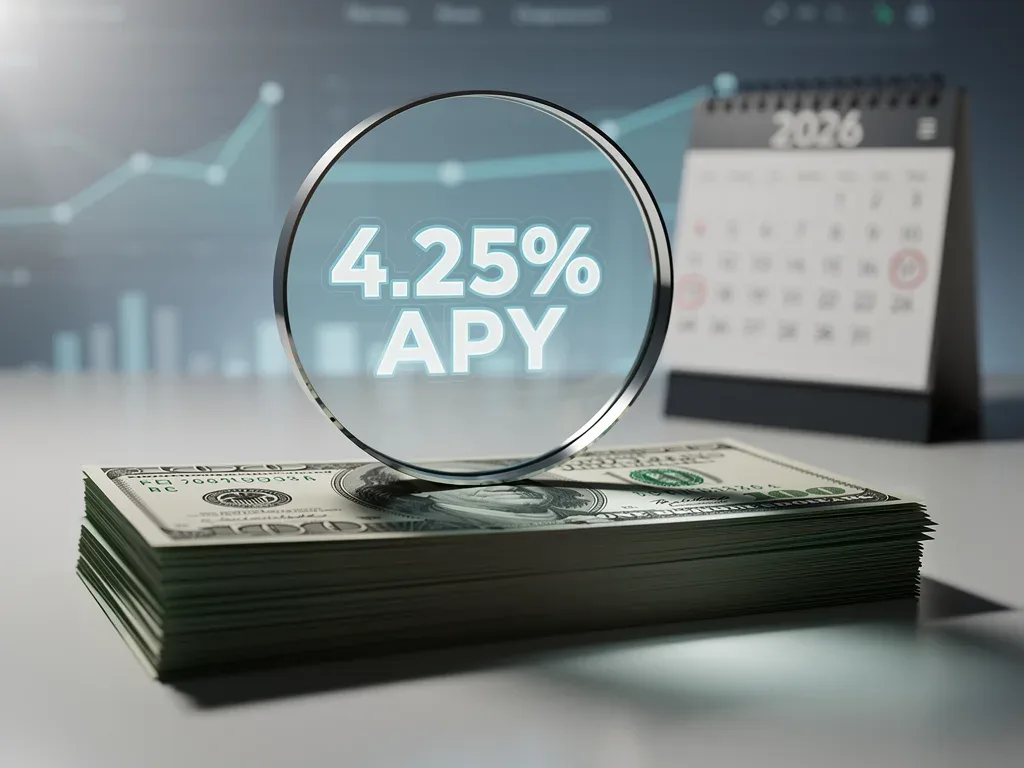
Latest developments on high-yield savings accounts in 2026 show that competitive savings rates remain available, but the market no longer broadly supports the idea that standard high-yield accounts are consistently paying more than 4.25% APY.
As of September 2026, many of the stronger broadly available savings accounts are clustered around 4% APY, with some higher advertised rates tied to specific balance, checking, direct-deposit, or promotional requirements.
For cash reserves, the most important considerations are current APY, federal deposit insurance, fees, minimum balances, withdrawal access, and whether the advertised rate is conditional or temporary.
The Current High-Yield Savings Landscape in 2026
High-yield savings accounts continue to pay substantially more than many traditional savings products, especially at online banks and selected credit unions.
Bankrate reported a national average savings yield of about 0.64% as of September 21, 2026, while leading high-yield accounts were paying around 4%.
This difference makes high-yield savings particularly relevant for emergency funds and short-term cash that needs to remain accessible without taking market risk.
Is 4.25% APY Still a Realistic Benchmark?
A 4.25% APY target is no longer an appropriate benchmark for every high-yield savings account in September 2026.
NerdWallet's current high-yield savings comparison lists a maximum of 4.21% APY, and that rate requires specific linked-account and funding conditions.
Rates above that level may still appear through promotions, specialized products, relationship requirements, or other high-interest accounts, but they should not be presented as the standard savings-account market rate.
Why Advertised Rates Need Context
An advertised APY may apply only when customers maintain a certain balance, establish direct deposit, link another account, or satisfy monthly activity requirements.
Promotional bonuses can also temporarily push an account above its standard rate before dropping back when the promotional period ends.
Always read the account disclosure to determine whether the headline APY applies to the entire balance and whether requirements must be met each month.
Standard APY: The normal variable rate paid without a temporary promotion.
Conditional APY: A higher rate available only after meeting specific requirements.
Promotional APY: A temporary increase that may expire after a few months.
What Major Online Banks Are Paying in September 2026
Several familiar online banking brands continue to offer savings products, but their current APYs differ meaningfully from the rates often quoted in older articles.
Marcus by Goldman Sachs was advertising a 3.50% standard Online Savings Account APY around September 19–20, 2026, while Ally Bank listed 3.00% APY as of September 10.
These rates remain competitive relative to many traditional savings accounts, but they do not support describing those institutions as standard examples of accounts paying above 4.25%.
Marcus by Goldman Sachs
Marcus listed a standard Online Savings Account APY of 3.50% in late September 2026 with no minimum balance requirement for the savings account.
The bank also offered a referral promotion that could add 1.00 percentage point to the savings APY for three months under applicable terms.
This distinction matters because a promotional boosted rate should not be described as the permanent standard APY.
Ally Bank
Ally listed a 3.00% APY on its online savings account as of September 10, 2026.
The account had no minimum balance requirement to earn the stated APY and no monthly maintenance fee, although Ally applies limits to certain types of withdrawals and transfers.
For savers, Ally may still be attractive because of features and access, but it should be evaluated on current terms rather than on historically higher rates.
Accounts Near the Top of the Market
NerdWallet reported that Axos Bank offered up to 4.21% APY as of September 21, 2026 when customers met linked checking and funding requirements.
Climate First Bank and Peak Bank were both listed around 4.01% APY with simpler opening requirements than the highest conditional offer.
These examples show why comparing eligibility conditions is just as important as comparing the headline rate.

How the Federal Reserve Affects Savings Rates
The Federal Reserve does not directly set savings-account APYs, but its federal funds target strongly influences short-term interest-rate conditions across the banking system.
On September 16, 2026, the Fed raised its target range by 0.25 percentage point to 3.75%–4.00%, marking its first increase since 2023.
That move may create upward pressure on some savings rates, but banks can respond at different speeds depending on deposit needs, competition, and funding strategy.
What the September 2026 Rate Hike Means
Higher short-term policy rates can make deposits more valuable to banks and may encourage some institutions to increase their savings yields.
However, a quarter-point Fed increase does not mean every savings account will immediately rise by a quarter point.
Consumers should monitor actual posted APYs rather than assume that Federal Reserve action automatically translates into matching account-rate increases.
Inflation Still Matters
The Federal Reserve reported that inflation remained above its 2% objective when it raised rates in September 2026.
For savers, the relevant comparison is not only the nominal APY but also how that yield compares with inflation over the same period.
A savings account can preserve liquidity and earn interest without necessarily producing a positive inflation-adjusted return in every environment.
What to Compare Beyond APY
The account with the highest advertised APY is not automatically the best place for every emergency fund or short-term savings balance.
Fees, minimum balance requirements, transfer speed, withdrawal rules, account-linking requirements, and rate tiers can materially affect usability.
For cash reserves, access and safety may be more important than gaining a few additional basis points of yield.
Monthly Fees and Minimum Balances
A monthly maintenance fee can reduce or eliminate the advantage of a higher APY, particularly on smaller balances.
Some banks require a minimum deposit to open an account, while others require a minimum balance to qualify for the advertised rate.
Always compare the effective cost of the account rather than looking only at the stated yield.
Liquidity and Transfer Access
Emergency savings should generally be accessible when an unexpected expense occurs, making transfer policies an important consideration.
Some banks allow broad withdrawal access, while others impose internal transaction limits or take several business days to move funds externally.
Review ACH timing, wire availability, ATM access where applicable, and any transaction restrictions before moving a large cash reserve.
FDIC and NCUA Protection
Deposit insurance is one of the most important protections when choosing where to hold short-term cash.
FDIC insurance generally covers qualifying deposits at insured banks up to $250,000 per depositor, per insured bank, for each account ownership category.
Federally insured credit unions receive comparable coverage through the National Credit Union Share Insurance Fund administered by the NCUA.
Insurance Limits Require Proper Structuring
The $250,000 figure is not simply a blanket limit across every account a person owns.
Coverage depends on depositor, institution, ownership category, and how accounts are legally titled.
Savers holding balances above standard insurance limits should review FDIC or NCUA coverage rules rather than assuming every dollar at one institution is protected.
Fintech Accounts Require Extra Verification
Some fintech companies offer savings or cash-management products through partner banks rather than operating as banks themselves.
In these arrangements, federal insurance may depend on how funds are placed, titled, and recorded at the underlying insured institution.
Consumers should identify the actual bank holding the deposits and review the program's insurance disclosures before relying on an FDIC-insured claim.
High-Yield Savings vs. CDs in Late 2026
Certificates of deposit can offer higher fixed yields than some savings accounts, but they require giving up some liquidity.
Marcus, for example, was offering a 4.35% APY on an 18-month High-Yield CD in September 2026, compared with a lower standard savings APY.
This illustrates the tradeoff between a fixed yield and immediate access to cash.
When a CD May Make Sense
A CD may be more appropriate for money that is unlikely to be needed before maturity.
The fixed APY protects against future rate declines during the term, but early withdrawal can trigger penalties unless the product is specifically designed as a no-penalty CD.
Emergency funds usually require more liquidity than a traditional CD provides.
When Savings May Be Better
A high-yield savings account allows customers to retain easier access to their money while earning a variable rate.
The tradeoff is that the bank can reduce the APY after the account is opened if market conditions change.
This flexibility often makes savings accounts more appropriate for emergency reserves and near-term expenses.
Should You Move Money Every Time Rates Change?
Rate shopping can improve interest income, but constantly moving money for very small rate differences may not always be worth the administrative effort.
The dollar impact depends on the account balance and the difference between the old and new APY.
Before switching, compare both the potential annual interest gain and any operational disadvantages of opening another account.
Calculate the Dollar Difference
A difference of 0.25 percentage point produces roughly $25 more annual interest per $10,000 before compounding and taxes, assuming rates remain unchanged.
On larger balances, small rate differences become more meaningful, while on smaller balances they may produce only modest additional earnings.
Calculating the expected dollar benefit can help determine whether moving the money is worthwhile.
The Role of Technology in High-Yield Savings
Online banking has made it easier to open accounts, link external banks, automate transfers, and monitor interest earnings.
Digital banks may also operate with fewer branch-related expenses, but lower overhead does not guarantee that a particular bank will always offer the highest APY.
Consumers should compare both digital functionality and financial terms rather than assuming online-only automatically means best rate.
Automatic Savings Tools
Automatic transfers can help users regularly move money into an emergency fund or short-term savings account.
Some platforms also offer savings buckets, goal tracking, and recurring-transfer features that can make cash management easier.
These features improve organization but should be evaluated separately from the actual interest rate and account costs.
Rate Alerts and Comparison Tools
Comparison websites can help identify changes in savings APYs, but displayed rates may lag behind a bank's own disclosures.
Before opening an account, verify the rate directly with the financial institution and confirm that the offer is available in your location.
Because savings rates are variable, the APY shown today can change after the account has been funded.
Economic Outlook and Rate Direction for Late 2026
The outlook changed in September when the Federal Reserve raised rates instead of continuing the easing cycle seen during parts of 2025.
Fed projections released in September showed a median federal funds rate projection around 4.1% for 2026, with a wide range of individual policymaker expectations.
This does not guarantee savings rates will rise, but it makes the late-2026 environment less favorable to assumptions that deposit yields are destined to keep falling.
Do Not Treat Fed Forecasts as Guaranteed
Federal Reserve projections reflect policymakers' expectations under their current economic outlook and can change as new data arrive.
Inflation, employment, growth, financial conditions, and geopolitical developments can all alter the path of future policy decisions.
Savers should therefore react to actual rates and account terms rather than trying to predict the exact future path of monetary policy.
Long-Term Strategy for Cash Reserves
High-yield savings accounts are most useful for money that needs principal stability and relatively easy access.
Emergency funds, tax reserves, near-term purchases, and other short-horizon goals often fit this profile better than long-term retirement savings.
Choosing the right account therefore starts with the purpose of the money rather than the highest available APY alone.
Emergency Funds
An emergency fund should prioritize safety and liquidity so the money can be used when an unexpected expense occurs.
An FDIC-insured bank or federally insured credit union with a competitive yield and reliable transfer access can provide a practical balance of those needs.
The appropriate emergency-fund size varies by household and should not be determined solely by the interest rate available.
Diversification Beyond Savings Accounts
Money that will not be needed for several years may have different objectives from cash reserves and may not need to remain entirely in savings accounts.
CDs, Treasury securities, bonds, and diversified investment portfolios each involve different combinations of risk, return, liquidity, and time horizon.
The appropriate choice depends on the goal and risk tolerance rather than on a universal rule that one product is superior.
Key Aspect | September 2026 Context |
|---|---|
Top Mainstream HYSA Range | Leading widely compared savings accounts are generally around 4%, with some conditional offers reaching about 4.21% APY. |
Federal Funds Rate | The Fed raised its target range to 3.75%–4.00% on September 16, 2026. |
Major Online Banks | Marcus was around 3.50% standard APY and Ally around 3.00% in September 2026. |
Security | Verify FDIC or NCUA insurance and understand ownership-category limits. |
Frequently Asked Questions About High-Yield Savings
Are high-yield savings accounts still paying over 4.25% in 2026? ▼
Some specialized, promotional, or conditional products may reach or exceed that level, but mainstream high-yield savings accounts in late September 2026 are generally closer to 4%, with major comparison lists topping out around 4.21%.
Are high-yield savings accounts safe? ▼
Deposits at FDIC-insured banks or federally insured credit unions are generally protected up to applicable federal insurance limits, provided the account and institution qualify for coverage.
How often can savings APYs change? ▼
Most high-yield savings rates are variable and can change at any time after account opening in response to bank funding needs, competition, and broader interest-rate conditions.
What fees should I check before opening an account? ▼
Review monthly maintenance fees, minimum-balance requirements, wire fees, transfer restrictions, inactivity fees, and any conditions required to earn the advertised APY.
Should I choose only online banks? ▼
No. Online banks often offer competitive yields, but credit unions, regional banks, and other insured institutions can also provide attractive savings products depending on current market conditions.
Looking Ahead: Strategic Cash Management
The landscape for high-yield savings accounts in 2026 remains competitive, but the market should be evaluated using current rates rather than outdated assumptions that 4.25% or higher is broadly available.
As we move further into 2026, the recent Federal Reserve rate increase may influence deposit pricing, but each institution will decide whether and when to adjust its APY.
For cash reserves, the strongest approach is to compare current yield, fees, liquidity, account requirements, and federal deposit insurance before deciding where to hold short-term savings.