Real Estate Syndications vs. Public REITs: 8% Yields & Tax Benefits
Advertisements
Real estate syndications vs REITs represent two very different ways to gain exposure to income-producing property, even though both ultimately depend on real estate performance.
Syndications typically provide interests in specific private deals, while publicly traded REITs allow investors to buy shares in professionally managed real estate companies through stock exchanges.
The comparison becomes more complex when investors consider headline yields, liquidity, leverage, depreciation, taxes and the possibility of losing part or all of their capital.
Understanding Real Estate Syndications
A real estate syndication generally pools money from multiple investors so a sponsor can acquire, finance and operate a property or portfolio.
The sponsor or general partner normally controls the business plan, financing, property management and eventual sale, while passive investors provide much of the equity.
Investors should understand that buying a syndication interest is an investment in a private security structure, not simply purchasing a fractional deed to a building.
Many Syndications Use Partnership Structures
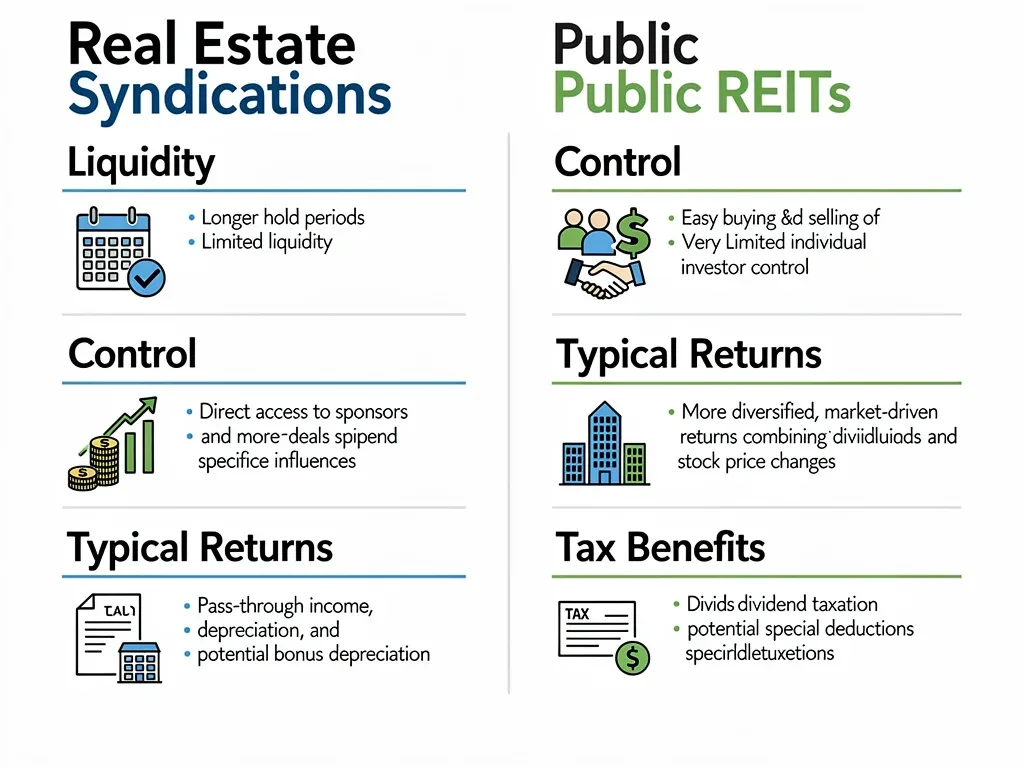
Syndications are frequently organized through limited liability companies or limited partnerships taxed as partnerships for federal income-tax purposes.
In those structures, taxable income, losses, depreciation and other tax items can generally be allocated among partners and reported through Schedule K-1.
The partnership agreement and tax rules determine those allocations, so two private real estate offerings can create very different economic and tax outcomes.
Limited Partners Are Usually Passive Investors
Limited partners generally do not make routine leasing, financing or property-management decisions because operational control rests primarily with the sponsor.
That structure makes syndications relatively hands-off, but it also creates meaningful sponsor risk because investors depend heavily on another party's judgment and execution.
Investors should therefore evaluate the sponsor as carefully as the property, including experience, fees, previous deals, conflicts and communication practices.
Public REITs Offer a Different Structure
A publicly traded real estate investment trust is a company whose shares can be bought and sold through a securities exchange like other listed investments.
REITs can own apartments, warehouses, data centers, healthcare properties, shopping centers, hotels and many other income-producing real estate categories.
Instead of investing in one identified private property, shareholders generally gain exposure to the portfolio and operating strategy controlled by the REIT's management team.
REITs Must Meet Specific Federal Tax Requirements
REIT status depends on satisfying detailed income, asset, ownership and distribution rules established under federal tax law.
Among those requirements, a qualifying REIT generally must distribute at least 90% of its taxable income, with statutory adjustments, to shareholders.
That rule helps explain the income-oriented nature of many REITs, but it should not be interpreted as a guarantee of a particular dividend yield.
An 8% Yield Is Not a Standard Benchmark
An 8% figure may appear in private syndication projections or in the current dividend yield of certain public REIT shares.
However, neither investment structure promises an 8% return, and the meaning of that percentage can differ substantially depending on how it is calculated.
Investors should first identify whether a number represents current yield, preferred return, projected cash-on-cash return, distribution rate or total-return target.
Projected Syndication Returns Are Not Guaranteed
A sponsor may underwrite a property using assumptions about rent growth, occupancy, expenses, financing and the price at which the asset could eventually be sold.
If those assumptions prove too optimistic, actual cash distributions and total investor returns can fall materially below the original projection.
A projected 8% cash-on-cash return should therefore be examined as an underwriting assumption rather than a promised investment result.
A High REIT Yield Can Reflect a Falling Share Price
Public REIT dividend yield generally compares annualized distributions with the current market price of the shares.
If the share price falls sharply while the dividend initially remains unchanged, the quoted yield can rise even though the investment has become riskier.
A high yield can therefore represent attractive income, market concern about the business or expectations that the dividend may eventually be reduced.
Look Beyond the Headline Yield
Income investors should examine the durability of distributions rather than selecting an investment solely because one percentage is higher.
For a private property, that means reviewing net operating income, debt service, occupancy, capital expenditures and the amount of cash reserved for unexpected costs.
For a REIT, investors can examine operating performance, leverage, dividend history and measures commonly used in the sector such as funds from operations.
Cash Distribution and Economic Return Are Different
An investment can distribute cash while simultaneously losing economic value because property prices or public share prices have fallen.
Conversely, a property may temporarily distribute little cash while increasing in value or reinvesting capital into improvements intended to raise future income.
Total return therefore combines income with changes in investment value rather than focusing exclusively on the size of current distributions.
Depreciation Can Be Powerful in Syndications
Buildings generally contain depreciable components, allowing qualifying real estate owners to recognize depreciation deductions over applicable recovery periods.
When a syndication is taxed as a partnership, depreciation allocated through the entity may appear among the tax items reported to individual partners.
This can cause taxable income from the investment to differ substantially from the cash actually distributed during a particular year.
Depreciation Does Not Mean Tax-Free Cash Forever
A private real estate investment can generate positive cash distributions while reporting a smaller amount of taxable income because depreciation is a noncash deduction.
That timing benefit can be valuable, but depreciation also affects tax basis and can have consequences when the property or partnership interest is eventually sold.
Investors should therefore evaluate lifetime tax consequences rather than treating an early depreciation deduction as permanent elimination of tax.
Cost Segregation Can Accelerate Some Deductions
Cost segregation studies can identify building components that qualify for shorter depreciation periods than the main building structure.
That reclassification can accelerate deductions into earlier years instead of waiting for all depreciable costs to be recovered over the building's longer schedule.
The actual benefit depends on property characteristics, current tax law, investment structure and the investor's ability to use the resulting deductions.
Accelerated Depreciation Is Primarily a Timing Strategy
Receiving larger deductions earlier can improve tax deferral and increase the present value of deductions compared with receiving them many years later.
However, accelerated deductions do not necessarily increase the total economic profit generated by the property itself.
Investors should distinguish between better tax timing and better operating performance when evaluating a sponsor's projected return.
Passive Loss Rules Can Limit Syndication Benefits
One of the biggest errors in discussions of private real estate is assuming depreciation losses can automatically offset salary, bonuses or unrelated investment income.
Rental activities are generally treated as passive activities for federal tax purposes, and limited partners normally face restrictive material-participation rules.
As a result, passive losses generally offset passive income unless an exception applies or suspended losses become usable under applicable tax rules.
Unused Passive Losses May Be Suspended
If an investor receives a passive loss larger than the passive income available to absorb it, the excess generally is not simply lost forever.
Disallowed passive losses can normally be carried forward and potentially used against qualifying passive income in later years.
Rules can also permit remaining suspended losses in certain circumstances when the investor disposes of the entire interest in a fully taxable transaction.
Basis and At-Risk Rules Create Additional Limits
Passive activity rules are not the only restrictions affecting whether a syndication investor can deduct a tax loss reported on Schedule K-1.
The IRS also imposes basis limitations and at-risk limitations before the passive activity rules are applied to partnership losses.
A large depreciation allocation on a tax document therefore does not automatically equal an immediately deductible amount on the investor's personal return.
Tax Position Is Investor-Specific
Two investors holding similar interests in the same syndication can experience different usable deductions because their basis, at-risk amounts and other passive activities differ.
Real-estate-professional status and material participation can also affect the treatment of certain rental real estate activities under federal rules.
Tax projections should therefore be evaluated using the investor's complete circumstances rather than relying only on a sponsor's generic tax illustration.
Public REIT Investors Do Not Receive Property Depreciation Directly
A shareholder in a public REIT generally owns shares of the REIT rather than a direct partnership interest in each property held by the company.
The REIT calculates depreciation at the entity level as part of its taxable-income and financial-reporting framework.
Shareholders therefore generally do not receive a Schedule K-1 allocating their personal share of each building's depreciation simply because they own common REIT shares.
REIT Tax Benefits Still Reach Investors in Other Ways
Depreciation can reduce taxable income inside the REIT and influence the amount and tax characterization of distributions paid to shareholders.
Some REIT distributions can also contain capital-gain distributions or amounts classified as return of capital rather than ordinary dividend income.
The tax result is therefore more nuanced than saying public REIT investors receive no benefit whatsoever from real estate depreciation.
Qualified REIT Dividends Can Receive Section 199A Treatment
Many ordinary REIT dividends do not receive the same preferential federal tax rate that applies to traditional qualified corporate dividends.
However, eligible taxpayers can generally include qualified REIT dividends when calculating the Section 199A deduction under current federal law.
The REIT component can generally equal up to 20% of qualified REIT dividends, subject to the broader limitations governing the taxpayer's deduction.
Not Every REIT Distribution Is a Qualified REIT Dividend
Capital-gain distributions are treated separately, while return-of-capital distributions generally reduce the shareholder's adjusted basis rather than constituting an ordinary dividend.
Holding-period and other requirements can also affect whether a distribution qualifies for the Section 199A REIT component.
Investors should therefore use the classifications reported on Form 1099-DIV instead of assuming every dollar distributed by a REIT receives identical tax treatment.
Return of Capital Is Not Free Income
A nondividend distribution classified as return of capital generally reduces the investor's adjusted cost basis in the REIT shares.
This can defer current tax, but a lower basis can increase taxable gain when the shares are later sold.
Once basis is reduced to zero, additional distributions can receive different tax treatment under applicable federal rules.
Tax Deferral and Tax Elimination Are Different
Both private real estate and REIT structures can produce situations in which current cash received exceeds currently taxable income.
That does not necessarily mean the economic return permanently escapes taxation because basis adjustments and sale transactions can create future tax consequences.
Investors should therefore distinguish tax deferral from permanent tax savings when comparing after-tax projected returns.
Public REITs Provide Strong Liquidity
A major advantage of publicly traded REITs is that investors can generally buy or sell shares during normal market hours through a brokerage account.
This gives shareholders access to their capital without waiting for an underlying building to be refinanced or sold.
That liquidity can be particularly important for investors who expect changing financial needs or want to rebalance a portfolio regularly.
Liquidity Does Not Eliminate Price Risk
The ability to sell quickly does not guarantee that the investor will be able to sell at the original purchase price.
REIT share prices can decline because of interest rates, property fundamentals, leverage, investor sentiment or broader stock-market conditions.
Public liquidity means an investor can realize the market price immediately, including when that price represents a substantial loss.
Syndications Can Lock Capital Up for Years
Private real estate syndications commonly operate around multi-year business plans involving acquisition, renovation, stabilization and eventual sale or refinancing.
Investors may have limited or no practical ability to sell their interests before the sponsor executes the planned exit.
Projected hold periods should therefore be interpreted as estimates rather than guaranteed dates on which investors will receive their capital back.
Secondary Markets May Be Extremely Limited
Private securities frequently carry resale restrictions and may not have an active market where an investor can readily find a buyer.
Even when transfers are technically permitted, partnership agreements may impose sponsor approval, eligibility requirements or other limitations.
Capital committed to a syndication should generally be money the investor can afford to leave invested through an uncertain holding period.
Private Syndications Can Have Eligibility Restrictions
Many syndicated real estate offerings rely on exemptions from full SEC registration, including offerings conducted under Regulation D.
Depending on the exemption used, participation may be restricted largely or entirely to accredited investors or may impose additional conditions on non-accredited investors.
Being financially eligible to invest does not mean the offering is suitable, safe or likely to produce its projected returns.
Accredited Investor Status Is Not a Quality Certification
Federal accredited-investor standards include financial and certain professional criteria intended to identify investors eligible for many private-market offerings.
For individuals, common financial thresholds include net worth exceeding $1 million excluding the primary residence or specified levels of annual income.
These rules govern access to offerings but do not mean the SEC has approved the property, sponsor, valuation or projected investment performance.
REITs Can Provide Broad Diversification
A large public REIT may own dozens, hundreds or even thousands of properties across multiple cities or regions.
This can reduce dependence on a single tenant or building compared with an investor participating in one standalone private syndication.
Investors can also hold several REITs across different property sectors to broaden real estate exposure further.
Diversification Does Not Remove Sector Risk
A REIT focused on offices, hotels or another specialized property sector can still be highly exposed to economic conditions affecting that category.
Geographic concentration, major tenants and financing structures can create additional risks even when the REIT owns many individual properties.
Investors should examine portfolio composition rather than assuming every listed REIT automatically provides broad diversification.
Syndications Can Create Concentration Risk
Investing a large amount in one apartment complex, industrial project or commercial building ties performance closely to that specific asset.
A local economic downturn, large tenant loss, unexpected repair or refinancing problem can materially affect distributions and final sale proceeds.
Achieving diversification through private deals often requires significantly more capital because an investor may need positions across multiple separate syndications.
Specific Exposure Can Also Be Intentional
Some investors prefer syndications precisely because they can select a particular property type, location and business plan rather than buying a broad portfolio.
This targeted exposure can be valuable when the investor understands the market and deliberately wants concentration in a specific strategy.
Greater specificity should be recognized as both an opportunity and an additional source of risk.
Sponsor Risk Is Central to Private Real Estate
Private investors frequently depend on the sponsor to select financing, control expenses, supervise managers and decide when to refinance or sell the asset.
A strong property can still deliver disappointing returns if the sponsor overpays, uses excessive leverage or executes the business plan poorly.
Due diligence should therefore extend beyond attractive photos, market-growth projections and the headline preferred return.
Review Fees and Incentives Carefully
Sponsors may receive acquisition fees, asset-management fees, financing fees, disposition fees and a share of investment profits depending on the offering.
These fees can compensate legitimate work but also affect how much of the property's economic return ultimately reaches passive investors.
The offering documents should explain the fee structure, waterfall and circumstances under which the sponsor receives additional compensation.
Public REITs Have Management Risk Too
REIT shareholders also rely on management teams to allocate capital, issue debt, acquire properties and decide whether to sell assets.
Poor acquisitions, excessive leverage or weak strategic decisions can damage shareholder value despite the liquidity and transparency of the public market.
Public reporting makes financial information easier to access, but it does not eliminate the risk of management making unsuccessful decisions.
Governance Is More Visible in Public Markets
Public REITs generally file regular financial reports and disclose substantial information about operations, debt, properties and management decisions.
Investors can analyze these disclosures and compare performance with other publicly traded companies using standardized financial information.
Private syndication disclosures can be extensive as well, but ongoing transparency and reporting practices vary considerably among sponsors.
Interest Rates Affect Both Structures
Real estate frequently relies on debt, making financing costs an important consideration for both private syndications and public REITs.
Higher borrowing costs can reduce cash flow, pressure property valuations and make refinancing more difficult when existing loans mature.
The exact impact depends on leverage, debt maturity, fixed versus floating rates and the ability to increase rental income.
Refinancing Risk Can Be Critical in Syndications
A private deal financed with short-term or floating-rate debt can face serious pressure if rates rise before stabilization or refinancing occurs.
Lower property valuations can also make it harder to obtain a new loan large enough to repay the existing balance.
Investors should examine debt maturity, interest-rate protection and assumptions about future refinancing before committing capital.
Private Property Values Do Not Move Daily
A private syndication does not display a new quoted market price every trading day, creating the appearance of lower volatility than public REIT shares.
That does not mean the underlying property's economic value is stable, because rents, interest rates and capitalization rates can still change.
The difference is partly one of valuation frequency rather than proof that private real estate carries less economic risk.
Public Prices Reveal Volatility Immediately
REIT shares respond continuously to new information, allowing prices to move long before appraisals of comparable private properties are updated.
This can make public real estate appear more volatile even when the underlying economic risks affect both public and private owners.
Investors should therefore avoid equating infrequent private valuations with guaranteed capital stability.
Neither Structure Guarantees Capital Appreciation
Real estate values can fall when interest rates rise, local demand weakens, operating expenses increase or income fails to meet expectations.
Syndication underwriting often includes an assumed exit capitalization rate or sale value, but future buyers determine what the property is ultimately worth.
REIT shareholders face the same fundamental reality through market prices that incorporate expectations about future property income and valuations.
Leverage Magnifies Outcomes
Debt can increase equity returns when properties perform well because investors control assets worth more than the equity they contributed.
The same leverage can magnify losses when income declines or property values fall relative to the debt outstanding.
Comparisons of projected return should therefore consider leverage rather than judging two investments solely by their distribution yields.
Real Estate Syndications vs REITs at a Glance
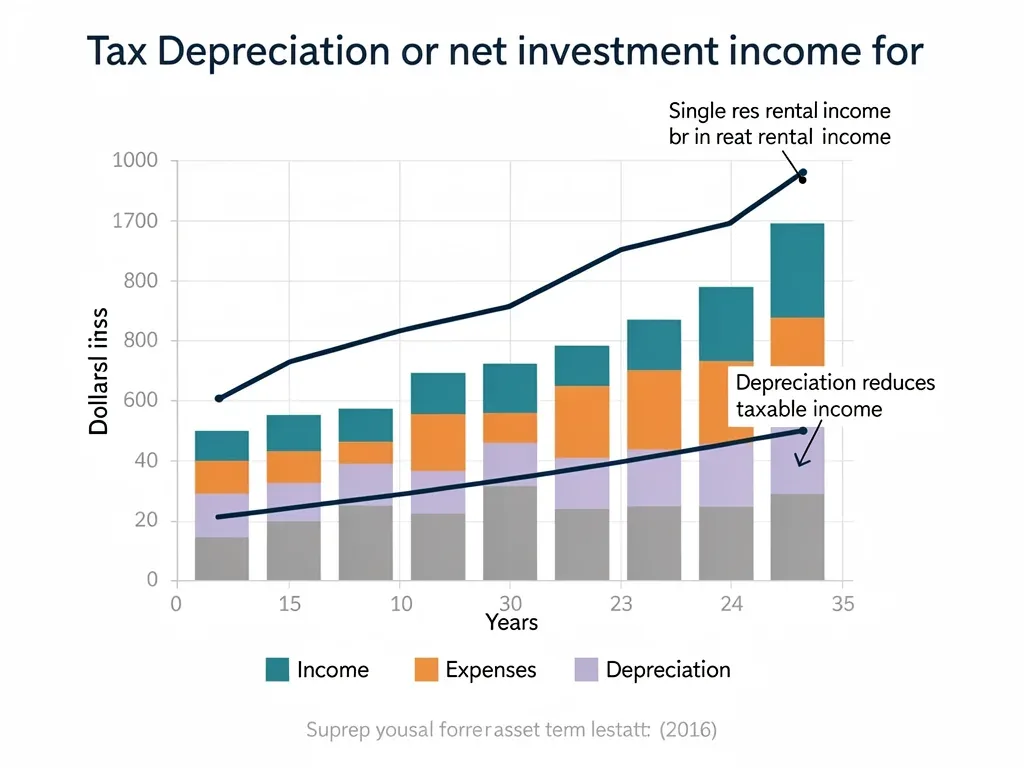
The real estate syndications vs REITs decision involves far more than comparing an 8% projected distribution with an 8% quoted dividend yield.
Private syndications offer targeted asset exposure and potential partnership tax allocations but introduce illiquidity, sponsor risk and complex tax limitations.
Public REITs provide easier access, liquidity and broad diversification while exposing investors to public-market volatility and a different tax-reporting structure.
Compare After-Tax Risk-Adjusted Outcomes
Tax treatment matters, but an investment should not be selected solely because depreciation may reduce taxable income during the early years.
A poor-performing property does not become a good investment simply because it generates substantial tax deductions.
Investors should evaluate cash flow, capital risk, liquidity, leverage, fees and taxes together before comparing potential outcomes.
Investment Aspect | Real Estate Syndication | Public REIT |
|---|---|---|
Liquidity | Typically limited for several years. | Shares generally trade daily on public exchanges. |
Asset Exposure | Usually specific properties or private portfolios. | Can provide exposure to large property portfolios. |
Tax Reporting | Often Schedule K-1 when structured as a partnership. | Shareholders generally receive Form 1099-DIV. |
Depreciation | May pass through to partners, subject to tax limitations. | Used at the REIT level rather than allocated as direct property depreciation to ordinary shareholders. |
Yield | Projected cash distributions are not guaranteed. | Dividend yield changes with distributions and market price. |
Primary Additional Risk | Sponsor, property, leverage and illiquidity risk. | Public-market volatility, management and sector risk. |
Frequently Asked Questions About Real Estate Investments
Do real estate syndications guarantee an 8% return?
No. An 8% preferred return or projected cash yield is an investment target or distribution structure, not a guarantee that investors will actually receive that return.
Does an 8% REIT yield mean the REIT is attractive?
Not necessarily. A high yield can result from a falling share price and may indicate greater financial, property-sector or dividend-cut risk.
Do syndication investors receive depreciation?
Partnership investors can receive allocations of depreciation and other tax items through Schedule K-1, depending on the structure and partnership agreement.
Can depreciation losses offset my salary?
Often not directly. Basis, at-risk and passive activity rules can limit when and against which income those losses may be deducted.
Do REIT shareholders receive property depreciation deductions?
Ordinary public REIT shareholders generally do not receive direct allocations of each property's depreciation through a partnership K-1.
Are REIT dividends taxed as ordinary income?
Many REIT dividends are ordinary REIT dividends, but distributions may also include capital gains or return of capital and can receive different federal tax treatment.
Can qualified REIT dividends receive the Section 199A deduction?
Yes. Eligible taxpayers may generally include qualified REIT dividends when calculating the Section 199A deduction, subject to applicable requirements and limitations.
Are syndications more diversified than REITs?
Usually not when comparing one syndication with a large diversified REIT, because one private deal may depend heavily on a single property or local market.
Can I sell a syndication whenever I want?
Usually not easily. Private interests can have transfer restrictions and often lack a liquid secondary market.
Are public REITs less risky because they are liquid?
No. Liquidity makes shares easier to sell, but their market prices can decline substantially and investors can still experience capital losses.
Are all syndications limited to accredited investors?
No. Offering rules differ, although many private placements restrict or largely target accredited investors depending on the securities exemption used.
Which is better for income investors?
Neither structure is universally better; the answer depends on income needs, liquidity, taxes, diversification, risk tolerance and the quality of the specific investment.
Conclusion
The real estate syndications vs REITs comparison should focus on structure, risk and after-tax economics rather than assuming either vehicle reliably produces an 8% yield.
Syndications can provide valuable depreciation allocations and targeted private real estate exposure, but tax losses are subject to important limitations and capital can remain locked up for years.
Public REITs offer liquidity, easier diversification and potentially favorable tax treatment for certain distributions, making careful deal-by-deal analysis more important than choosing one structure categorically.