Special Education Funding Updates for 2026: What You Need to Know
Advertisements
Special Education Funding Updates for 2026 center on the continued implementation of IDEA formula grants, new 2026 state compliance determinations and the way federal, state and local resources support services for students with disabilities.
There is no new nationwide IDEA funding formula taking effect in 2026, making it important to distinguish current policy from proposals or state-specific changes.
Special Education Funding Updates for 2026: How New Policies Affect Resource Allocation Nationally are best understood through the existing Individuals with Disabilities Education Act framework rather than as a nationwide replacement of the special education finance system.
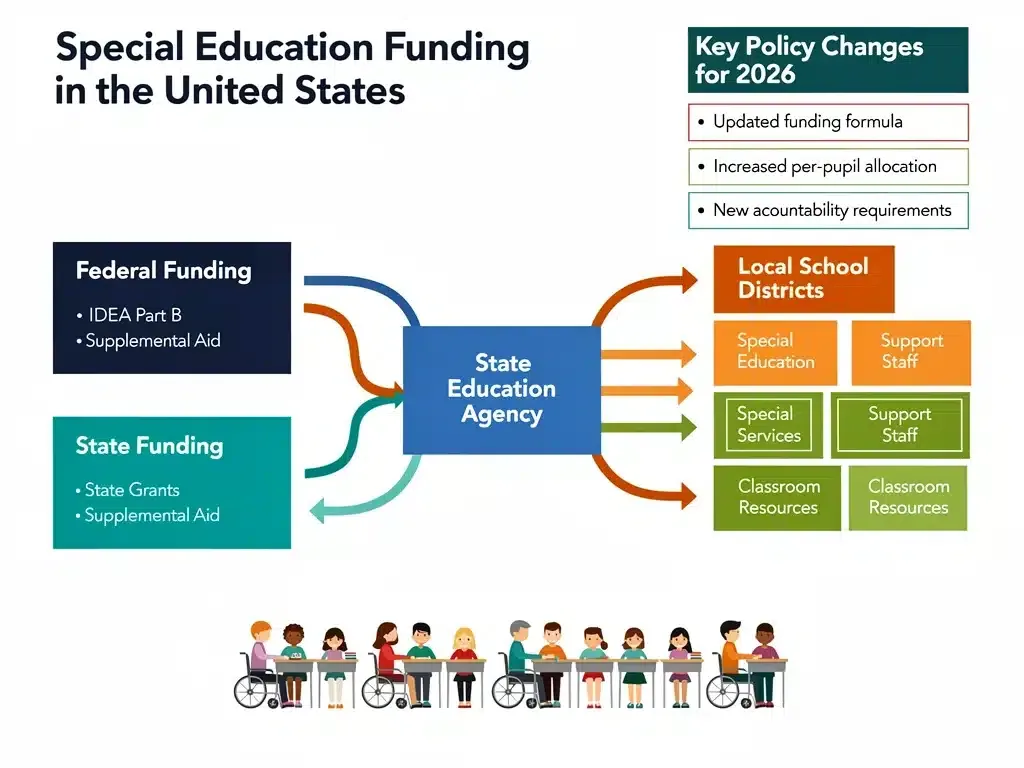
Federal IDEA money continues to supplement substantial state and local spending, while states remain responsible for distributing much of their Part B funding to local educational agencies under established statutory formulas.
For educators, administrators and families, the most relevant developments in 2026 involve state grant implementation, maintenance-of-effort requirements, federal monitoring, staffing pressures and how districts use available resources to provide a free appropriate public education.
How Special Education Funding Works in 2026
The Individuals with Disabilities education funding Act remains the central federal law governing special education services and federal formula grants for students with disabilities in the United States.
IDEA Part B includes Grants to States under Section 611 for eligible children and youth, along with Preschool Grants under Section 619 for eligible children ages three through five.
These federal resources are combined with state and local funding to help school systems provide special education and related services required under the law.
The Federal Formula Has Not Been Replaced
The original article suggested that a revised federal formula would take effect in 2026, but the current IDEA Part B allocation framework remains based on the statutory formula already established under Section 611.
States first receive a base amount linked to fiscal year 1999, while increases above the prior-year program level are generally distributed using population and poverty factors.
Under that framework, 85% of applicable additional funding is based on the relevant population and 15% is based on children living in poverty within the applicable age range.
Federal Fiscal Year 2026 Grants Are Moving Through Implementation
For Federal Fiscal Year 2026, state educational agencies were required to submit their IDEA Part B application materials to the Office of Special education funding Programs.
The Department of Education instructed states to submit substantially approvable applications by May 20, 2026 to support timely access to the portion of federal funds becoming available July 1.
Additional forward-funded amounts become available according to the federal appropriations structure, meaning special education funding does not arrive in one single nationwide payment at the beginning of the school year.
Application Timing Can Affect When States Obligate Funds
A state that submitted a substantially approvable FFY 2026 application by the required timeline could generally begin its federal funding period on July 1, 2026.
If an application was submitted late or was not yet substantially approvable, the date on which the state could begin obligating federal funds could occur later.
This administrative process matters because federal approval affects when states can formally begin using a particular fiscal year’s IDEA award, even though special education services themselves continue under existing legal obligations.
Most IDEA Part B Money Ultimately Supports Local Services
States receive IDEA Part B Grants to States, but most federal funding that is not reserved for permitted state-level activities must be passed through to local educational agencies.
Districts then combine federal allocations with state and local resources to pay the excess costs associated with providing special education and related services.
This means national funding announcements do not translate into identical per-student amounts because local allocations depend on formulas, enrollment, poverty measures and state funding structures.
Federal Funding Can Support Teachers and Related Services
IDEA Part B funds can support eligible costs such as special education teacher salaries and related-services personnel, including professionals such as speech-language specialists and psychologists.
State-level funds may also support technical assistance, personnel preparation, behavioral interventions, monitoring activities and improvements in the use of educational technology.
Districts must still follow IDEA fiscal requirements, meaning federal money cannot simply be treated as unrestricted revenue available for any general education expenditure.
- Special education teachers and eligible instructional personnel.
- Related services required for eligible students.
- Technical assistance and personnel development.
- Positive behavioral interventions and supports.
- Eligible technology and accessibility improvements.
Maintenance of Effort Remains a Major Budget Requirement
IDEA contains fiscal safeguards designed to prevent federal special education funding from simply replacing existing state and local financial commitments.
States generally must maintain their financial support for special education and related services from one year to the next, subject to applicable statutory rules and exceptions.
Local educational agencies also operate under maintenance-of-effort requirements that affect how districts plan budgets and determine whether reductions in local special education spending are permissible.
Federal Grants Are Intended to Supplement Local Capacity
Federal IDEA money helps districts address the excess costs of educating students with disabilities rather than assuming responsibility for the entire cost of special education.
State and local governments therefore continue to provide a substantial portion of the resources needed for personnel, transportation, therapies, facilities and instructional support.
Understanding this funding structure is important when evaluating claims that a change in one federal appropriation will automatically produce an equivalent change in every local special education budget.
The 2026 IDEA State Determinations Are a Major Current Development
On June 18, 2026, the U.S. Department of Education issued its annual determinations evaluating state implementation of IDEA Parts B and C.
The determinations use information from State Performance Plans and Annual Performance Reports and evaluate both compliance with IDEA requirements and results for children and families.
These determinations are more relevant to the current 2026 policy landscape than claims of a newly rewritten national funding formula because they can trigger technical assistance and enforcement consequences.
States Received Different Part B Determinations
The Department classified 21 jurisdictions as meeting IDEA Part B requirements in its 2026 determinations, while other jurisdictions were placed in varying levels of needed assistance or intervention.
Maryland, Minnesota and North Dakota were listed as needing assistance for one year, while numerous other states and territories were identified as needing assistance for two or more consecutive years.
The Bureau of Indian Education, District of Columbia, Maine, New Mexico, New York and Vermont were classified as needing intervention under the 2026 Part B determinations.
Federal Monitoring Can Affect How Resources Are Managed
When a state receives a determination of “needs assistance” for two or more consecutive years, IDEA requires the Department of Education to take one or more specified enforcement actions.
Those actions can include requiring technical assistance, identifying a state as a high-risk grantee or directing the use of state-level IDEA funds toward identified areas of concern.
The practical effect is that federal oversight can influence resource priorities even without Congress rewriting the underlying IDEA funding formula.
Accountability Is Not Based Only on Spending Levels
Federal monitoring examines whether states are implementing IDEA requirements and improving outcomes rather than judging programs solely by how much money they spend.
Compliance indicators and student or family results are incorporated into the State Performance Plan and Annual Performance Report framework used by OSEP.
This means a larger budget alone does not establish successful implementation if the state continues to experience significant compliance or outcome problems.
State Funding Systems Still Create Major National Differences
Federal IDEA requirements apply nationwide, but states finance special education through different education formulas, categorical programs and reimbursement structures.
Some states provide additional weights for students receiving special education, while others use separate grants, cost reimbursement or combinations of different mechanisms.
Consequently, two districts receiving comparable federal IDEA support can still have substantially different overall resources because their state and local finance systems differ.
Local Costs Can Vary Substantially
The cost of providing an individualized education program depends on the services required by each eligible student rather than a fixed nationwide amount.
District expenses can include specialized teachers, aides, transportation, speech-language services, occupational or physical therapy and other services required under an IEP.
Students with more intensive needs can therefore require substantially more resources than an average per-pupil funding figure suggests.

Staffing Remains One of the Most Important Resource Questions
Special education funding is closely connected with staffing because providing individualized instruction and related services requires appropriately trained professionals.
Districts may use eligible IDEA resources for special education teachers and related-services personnel, but available funding does not automatically guarantee that qualified workers can be recruited locally.
Salary competition, certification requirements, geographic location and workload can all influence whether districts can fill positions even when budget authority exists.
Professional Development Can Be an Eligible Use of Resources
IDEA funding can support eligible personnel preparation and technical-assistance activities intended to improve the capacity of schools to serve students with disabilities.
Training may address evidence-based instruction, behavior supports, accessibility, compliance responsibilities and implementation of individualized education programs.
Districts should connect professional development to documented educational needs rather than assuming every training initiative automatically qualifies for federal special education funding.
Assistive Technology Can Be Supported Without a New 2026 Earmark
The original article stated that a significant portion of new 2026 funding was specifically earmarked nationally for assistive technology, but that characterization is too broad.
IDEA allows eligible funding to support improvements in the use of technology and services that students need to receive a free appropriate public education.
Whether a specific device, software platform or accessibility tool is funded depends on program rules, student needs and state or local budgeting decisions.
Technology Should Follow Student Needs
Assistive technology can include communication systems, accessibility tools, specialized software and other devices that help eligible students participate in educational activities.
Under IDEA, educational planning should remain individualized, meaning technology decisions should relate to the student’s needs rather than a nationwide technology purchasing target.
Districts must also consider implementation, staff training and ongoing support because purchasing equipment alone does not guarantee meaningful educational access.
IDEA Preschool Grants Continue to Serve Ages Three Through Five
IDEA Part B Section 619 provides formula grants to states, the District of Columbia and Puerto Rico for special education and related services for eligible preschool children.
To participate, states must serve eligible children with disabilities ages three through five and maintain an approved IDEA Part B application.
Preschool Grants remain part of the existing IDEA structure in 2026 rather than being replaced by a new nationwide special education funding program.
Early Services Can Affect Later Resource Planning
Identifying developmental and educational needs early can help schools plan services before children move into elementary grades.
Preschool programs may coordinate special education teachers, related-service professionals and families through individualized educational planning.
The financial impact depends on state and local implementation, making it inappropriate to assume that every preschool program receives the same level or type of resources.
IDEA Part C Supports Infants and Toddlers
Separate from school-age Part B funding, IDEA Part C provides formula grants supporting early intervention services for infants and toddlers with disabilities and their families.
These services apply from birth through age two under a different component of IDEA and are administered through state lead agencies.
Distinguishing Part B from Part C is important because discussions of national special education funding often combine programs that serve different age groups and operate under different requirements.
Part C Also Receives Annual Federal Monitoring
The Department of Education issued 2026 state determinations for IDEA Part C alongside its determinations for Part B.
States were categorized according to whether they met requirements or needed varying levels of assistance or intervention based on federal performance and compliance measures.
This creates another accountability mechanism affecting early-intervention administration without changing the underlying statutory formula through a new 2026 reauthorization.
School Districts Must Track More Than Federal Allocations
Budget planning requires districts to monitor federal IDEA awards alongside state appropriations, local revenues, staffing obligations and individual student service requirements.
A change in enrollment or the needs identified through IEPs can increase spending even if the federal allocation remains relatively stable.
District leaders therefore need to evaluate both revenue and service obligations before concluding that an increase in one funding source creates additional discretionary resources.
High-Cost Students Can Create Significant Local Pressures
IDEA allows states, under specified conditions, to reserve a portion of state-level funds for mechanisms designed to assist LEAs with high-cost children with disabilities.
These arrangements recognize that some individualized programs can require levels of staffing, transportation or related services far beyond ordinary district costs.
State policies determine how such mechanisms operate locally, so districts should review their own state’s requirements and application procedures.
Early Intervening Services Have Specific Funding Rules
IDEA permits local educational agencies to use a limited portion of their Part B allocation for coordinated early intervening services under applicable conditions.
Generally, an LEA may use up to 15% of its allocation, less certain amounts associated with maintenance-of-effort flexibility, for eligible early intervening activities.
These services are intended for students who need additional academic or behavioral support but who are not currently identified as requiring special education.
Early Intervening Services Are Not the Same as Special Education
A student receiving early intervening support does not become eligible for IDEA special education services solely because that support is provided.
Special education eligibility requires the evaluation and eligibility process established under IDEA and applicable state requirements.
Districts therefore need to track these expenditures and populations carefully when using IDEA funds for early intervening activities.
Parents Continue to Have a Role in IDEA Implementation
Education funding decisions occur within a legal framework in which eligible students retain IDEA rights regardless of broad budget pressures affecting their district.
Parents participate in the individualized education program process and can raise concerns about services, evaluations, placement or implementation through established procedures.
Changes in federal or state appropriations do not automatically modify an individual student’s IEP or eliminate the district’s obligation to provide FAPE.
Public Participation Also Applies at the State Level
The Department’s FFY 2026 Part B application guidance requires states to observe public-participation requirements when revising policies and procedures related to IDEA implementation.
This creates opportunities for families, educators and other stakeholders to review certain proposed state changes and provide input through established processes.
Parents should therefore distinguish individual IEP advocacy from broader participation in state or district policy discussions because the two processes serve different purposes.
Research and Technical Assistance Remain Part of the 2026 Landscape
The Department of education funding continues to support technical-assistance and research activities related to improving services and outcomes for children with disabilities.
In August 2026, for example, the Department listed a FY 2026 National Center on Academic Interventions competition with an estimated $3.7 million available for one award.
Such discretionary programs are separate from the much larger IDEA formula grants provided to states and should not be confused with general per-student funding for local districts.
Research Grants Do Not Directly Determine Every District Budget
National centers and technical-assistance grants can develop resources, evidence and implementation support that eventually inform state and local practices.
However, receiving a national research or technical-assistance award does not mean every LEA receives an equivalent share of that grant.
When discussing special education finance, it is therefore important to distinguish formula funding, discretionary grants and state or local appropriations.
What Districts Should Monitor During the Rest of 2026
District leaders should monitor their final state and local allocations, IDEA grant conditions, state compliance guidance and changes in student service needs during the 2026–27 school year.
They should also review the implications of their state’s 2026 IDEA determination, particularly where repeated “needs assistance” findings trigger additional federal intervention.
Staffing capacity, related-service availability and maintenance-of-effort requirements are likely to remain practical budget pressures regardless of national political debate over funding levels.
Families Should Focus on Local Implementation
National funding totals provide important context but often do not show how much money reaches a particular classroom, school or individual service.
Families seeking information about local services should review district budgets, state IDEA resources and their child’s IEP rather than drawing conclusions from national appropriations alone.
School board meetings, state education agencies and parent information resources can also provide more specific information about how resources are being allocated locally.

What the 2026 Funding Picture Does Not Show
Federal funding figures cannot by themselves measure whether students receive effective instruction, appropriate services or positive educational outcomes.
Likewise, a state receiving a stronger IDEA compliance determination does not mean every district or student experience within that state is identical.
Financial data should therefore be evaluated alongside staffing, service delivery, compliance measures and student outcomes when assessing the condition of special education.
Avoid Treating Funding as a Single National System
Special education funding financing involves federal IDEA grants, state education formulas, local spending and services determined through individualized student needs.
That layered structure makes claims of one national 2026 resource-allocation model misleading because states and districts continue to operate under substantially different financial environments.
The federal government establishes important requirements and provides grants, but much of the actual cost and implementation remains at state and local levels.
| Key Point | 2026 Context |
|---|---|
| IDEA Formula | The existing statutory Part B formula remains in use; there is no new nationwide 2026 allocation formula. |
| FFY 2026 Grants | States submitted Part B applications for funds becoming available beginning July 1 and through the federal forward-funding process. |
| Federal Monitoring | The Department issued new IDEA Part B and Part C state determinations on June 18, 2026. |
| Local Budgets | Federal resources work alongside state and local funding and do not fully determine district special education spending. |
| What to Watch | State allocations, staffing, maintenance of effort, monitoring findings and implementation during the 2026–27 school year. |
Frequently Asked Questions About Special Education Funding 2026
Did the federal government introduce a new IDEA funding formula in 2026?▼No. IDEA Part B continues to use the statutory allocation framework that includes a base amount and population and poverty factors for applicable additional funding.
What changed for IDEA funding administration in 2026?▼States submitted FFY 2026 IDEA Part B applications, and eligible federal funding periods began as early as July 1, 2026 for substantially approvable applications submitted according to federal procedures.
Can IDEA funding pay for special education staff?▼Yes. Eligible IDEA Part B expenditures can include special education teachers and related-services personnel, although districts must comply with federal, state and local fiscal requirements.
What are the 2026 IDEA state determinations?▼They are annual federal evaluations of how states implement IDEA requirements and improve results. States can be classified as meeting requirements, needing assistance or needing intervention.
Does more federal funding automatically mean more services for every student?▼Not necessarily. Local services depend on student needs, state and local funding, district costs, staffing and IDEA requirements in addition to the federal allocation.
Looking Ahead: What Special Education Funding Means for 2026–27
Special education funding 2026 is defined more by implementation of the existing IDEA framework, annual federal grants and new state monitoring determinations than by a new nationwide funding formula.
For districts, the most important resource questions remain how federal, state and local money can support required services while addressing staffing costs, related services, maintenance of effort and individual student needs.
Educators, policymakers and families should continue monitoring state-level implementation and workforce conditions, including broader issues such as the teacher retention challenges affecting schools in 2026, rather than relying on unsupported claims of a single national funding overhaul.