Mega Backdoor Roth 401(k): Unlock $70,000 Tax-Free Retirement
Advertisements
The Mega Backdoor Roth 401(k) strategy allows eligible Americans to increase their tax-advantaged retirement savings by converting after-tax contributions into Roth funds, utilizing available contribution space within the $72,000 combined 401(k) limit for 2026.
The Mega Backdoor Roth 401(k) strategy offers an alternative for Americans seeking to increase their Roth retirement savings beyond standard annual employee contribution limits.
In 2026, eligible individuals can take advantage of higher retirement plan contribution limits, provided their employer-sponsored plans support the necessary after-tax contributions and conversion arrangements.
Understanding the eligibility requirements, contribution limits, tax implications, and implementation procedures is essential for individuals considering this advanced approach to long-term retirement planning.
Understanding the Mega Backdoor Roth 401(k) Mechanism
The Mega Backdoor Roth 401(k) involves making additional non-Roth after-tax contributions to an eligible workplace retirement plan before transferring those funds into a Roth account.
This strategy utilizes available contribution space remaining after accounting for regular employee contributions, employer matching payments, profit-sharing contributions, and other applicable additions to the retirement plan.
Depending on the employer's plan provisions, eligible funds may be transferred into a designated Roth 401(k) account or distributed through a rollover into a Roth IRA.
The Role of After-Tax Contributions
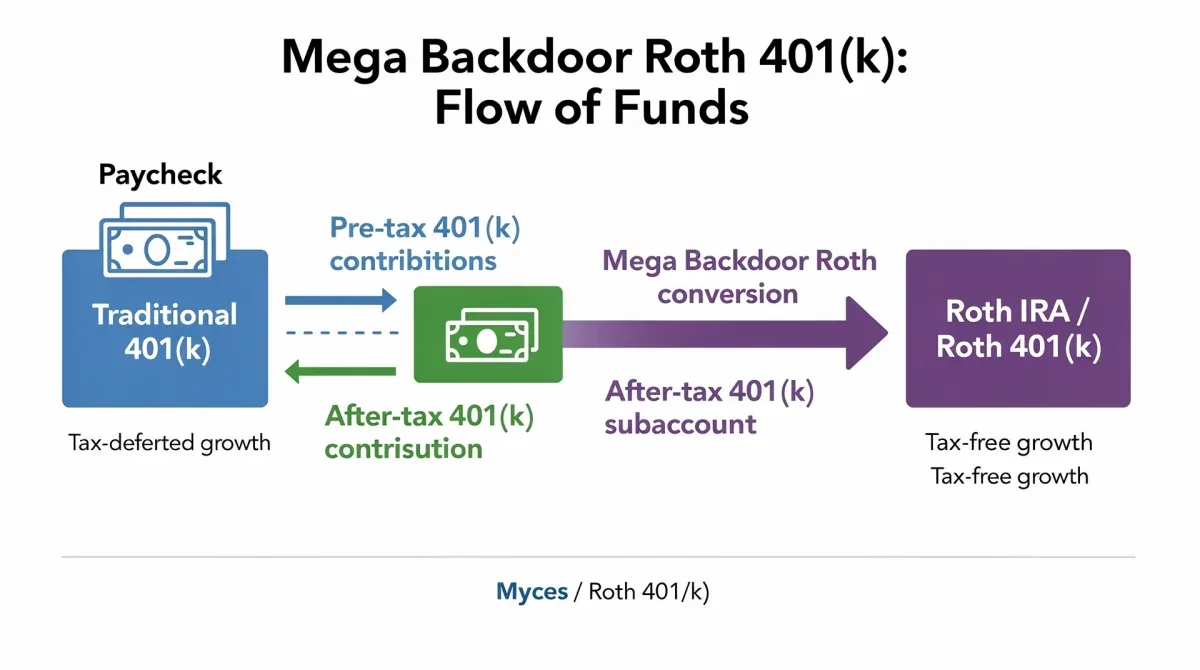
Non-Roth after-tax contributions are made using income that has already been subject to taxation, meaning participants generally do not receive an immediate income tax deduction.
These contributions differ from regular designated Roth 401(k) contributions because their investment earnings remain potentially taxable until transferred into an eligible Roth retirement account.
Understanding this distinction is fundamental to implementing the Mega Backdoor Roth 401(k), particularly when calculating available contribution space and evaluating the potential taxation of subsequent conversions.
In-Service Distributions and Roth Conversions
Some employer-sponsored retirement plans permit eligible participants to distribute certain after-tax funds while remaining employed, creating opportunities to transfer those amounts into a Roth IRA.
Other retirement plans offer in-plan Roth conversions, allowing participants to transfer eligible balances directly into a designated Roth account maintained within their existing workplace retirement plan.
Converting after-tax contributions relatively quickly may reduce taxable earnings accumulated before conversion, although the available timing and frequency depend on the employer's specific retirement plan provisions.
Eligibility and Plan Requirements for Mega Backdoor Roth 401(k)
Eligibility for the Mega Backdoor Roth 401(k) depends primarily on the provisions established within an individual's employer-sponsored retirement plan rather than exclusively on annual household income.
Participants should confirm that their employer permits non-Roth after-tax contributions beyond the standard employee elective deferral limit and provides an appropriate mechanism for subsequent Roth conversions.
Reviewing official retirement plan documentation and consulting the plan administrator can help individuals determine whether this strategy is available and compatible with their financial circumstances.
Key Features Your 401(k) Plan Must Have
A retirement plan supporting this strategy must generally permit voluntary non-Roth after-tax contributions that are separately accounted for from traditional and designated Roth salary deferrals.
The plan must also provide an appropriate conversion or distribution mechanism, allowing eligible after-tax funds to reach a designated Roth account or an external Roth IRA.
Without these provisions, individuals may need to explore alternative retirement savings strategies rather than assuming that every employer-sponsored 401(k) supports the Mega Backdoor Roth 401(k).
Understanding the 2026 Contribution Limits
According to the official IRS retirement contribution limits, the standard employee elective deferral limit for eligible 401(k) plans increased to $24,500 for the 2026 tax year.
The overall annual additions limit increased to $72,000, generally covering regular employee contributions, employer contributions, voluntary after-tax contributions, and other applicable additions, subject to compensation restrictions.
Eligible participants aged 50 or older may contribute additional catch-up amounts outside this combined limit, potentially increasing total retirement contributions to $80,000 or $83,250.
Catch-Up Contributions for Older Workers
In 2026, eligible retirement plan participants aged 50 or older generally have access to an additional catch-up contribution allowance of $8,000 beyond regular employee contribution limits.
Participants aged 60 through 63 may qualify for an enhanced catch-up contribution limit of $11,250, potentially increasing their total annual retirement plan contributions to $83,250.
Beginning in 2026, certain participants whose prior-year wages from their sponsoring employer exceeded $150,000 must generally make eligible catch-up contributions on a Roth basis.
Employer Contributions and Available After-Tax Space
Employer matching contributions and profit-sharing payments generally count toward the annual additions limit, reducing the remaining contribution space available for voluntary non-Roth after-tax retirement savings.
Individuals implementing the Mega Backdoor Roth 401(k) should account for expected employer contributions before determining the amount they can allocate toward additional after-tax retirement plan contributions.
Failure to consider employer payments or other applicable additions could result in excessive contributions, administrative corrections, or unexpected financial consequences requiring assistance from the plan administrator.
How Much Can You Contribute Using a Mega Backdoor Roth 401(k)?
The amount available through this strategy depends on existing retirement contributions, compensation, employer payments, plan-specific restrictions, and the annual contribution limits established under federal tax regulations.
Although the combined 2026 limit reaches $72,000, this figure does not represent an additional allowance exclusively available through the Mega Backdoor Roth 401(k) strategy.
Calculating the remaining contribution space provides a more accurate understanding of how much additional money an eligible individual may potentially transfer into a Roth retirement account.
Practical Contribution Example for 2026
Consider an employee younger than 50 who contributes the full $24,500 regular elective deferral amount to their workplace retirement plan during the 2026 tax year.
If their employer contributes an additional $7,500, combined contributions would reach $32,000, leaving up to $40,000 in potential additional contribution space under the $72,000 limit.
Provided the retirement plan supports the necessary contributions and conversions, this remaining amount could potentially be utilized through the Mega Backdoor Roth 401(k) strategy.
Contribution Example Without Employer Matching
An eligible employee younger than 50 who contributes $24,500 in regular salary deferrals without receiving employer contributions could potentially have $47,500 in remaining annual additions space.
This amount assumes there are no other applicable contributions, sufficient eligible compensation, and a retirement plan that permits voluntary after-tax payments up to the relevant limit.
Individual contribution opportunities may be lower because of employer-specific restrictions, nondiscrimination testing requirements, compensation limitations, or other conditions established within the retirement plan.
Strategic Advantages of the Mega Backdoor Roth 401(k)
The principal advantage of this retirement strategy involves increasing the amount of money allocated toward Roth accounts, potentially expanding opportunities for federally tax-free qualified distributions.
Unlike direct Roth IRA contributions, which are subject to income-based eligibility restrictions, eligible employer-plan Roth conversions can provide an alternative pathway for higher-income retirement savers.
The Mega Backdoor Roth 401(k) may also support greater tax diversification by allowing individuals to accumulate retirement assets across accounts with different taxation arrangements.
Tax-Free Growth and Qualified Withdrawals
Funds properly transferred into Roth retirement accounts can accumulate investment earnings without annual federal income taxation, while qualified distributions may be excluded from federal taxable income.
Qualified Roth 401(k) withdrawals generally require satisfaction of a five-tax-year participation period and an eligible event involving age 59½, disability, or the participant's death.
Roth IRA distribution requirements have their own applicable rules, making it important to understand the destination account before assuming that every withdrawal will be completely tax-free.
Estate Planning Considerations
Roth retirement accounts may provide estate planning advantages because original account owners generally are not required to take minimum distributions during their lifetimes.
However, inherited Roth accounts remain subject to beneficiary distribution requirements, with many non-spouse beneficiaries required to withdraw the account balance within an applicable ten-year period.
The Mega Backdoor Roth 401(k) may complement estate planning objectives, although inheritance taxation, beneficiary classifications, distribution deadlines, and individual circumstances require careful professional evaluation.
Greater Tax Diversification in Retirement
Maintaining both traditional and Roth retirement assets may provide additional flexibility when determining which accounts to use for retirement expenses during different financial circumstances.
Traditional retirement account withdrawals generally create taxable income to the extent amounts have not previously been taxed, while qualified Roth distributions receive different federal tax treatment.
This flexibility may help retirees manage taxable income, although the overall financial benefits depend on future tax rates, investment performance, and individual retirement spending requirements.
Navigating Potential Pitfalls and Tax Considerations
The Mega Backdoor Roth 401(k) involves multiple retirement plan and taxation rules that require careful attention before participants begin making additional contributions or transferring existing balances.
Potential challenges include taxable investment earnings, employer contribution limits, administrative restrictions, annual nondiscrimination testing, and differences between qualified employer-plan distributions and individual retirement account conversions.
Understanding these requirements can help individuals avoid assuming that every contribution, conversion, or withdrawal associated with this strategy automatically qualifies for favorable tax treatment.
Understanding the IRA Pro-Rata Rule
The IRA pro-rata rule generally applies when individuals convert traditional IRA funds into Roth IRAs while maintaining a combination of previously taxed and untaxed IRA balances.
For these calculations, traditional, SEP, and SIMPLE IRA balances are generally considered together, potentially making part of an IRA conversion taxable even when nondeductible contributions exist.
This IRA aggregation rule does not automatically apply to a direct qualified 401(k)-to-Roth IRA rollover simply because the participant holds separate traditional IRA balances.
Understanding the Pro-Rata Rules for 401(k) Distributions
Employer retirement plan distributions involving previously taxed contributions and untaxed amounts are generally subject to allocation rules that determine the taxable and nontaxable components of withdrawals.
IRS guidance under Notice 2014-54 permits eligible distributions to be directed toward different retirement accounts, allowing after-tax principal and pretax amounts to receive separate destination treatment.
Participants implementing the Mega Backdoor Roth 401(k) should coordinate these transfers with their plan administrator to understand how applicable distribution and allocation rules affect their individual circumstances.
Potential Taxation of Investment Earnings
Investment earnings accumulated on non-Roth after-tax contributions before conversion generally represent untaxed retirement plan amounts that may create taxable income when transferred into a Roth account.
Where permitted, eligible pretax earnings may instead be transferred to an appropriate traditional IRA or another compatible pretax retirement plan through properly coordinated rollover arrangements.
Making conversions promptly may limit earnings accumulated before conversion, although investment market movements and administrative processing times prevent participants from guaranteeing an entirely tax-free transaction.
Employer Nondiscrimination Testing and Contribution Restrictions
Employer-sponsored retirement plans may be subject to nondiscrimination testing requirements designed to prevent certain retirement benefits from disproportionately favoring highly compensated employees over other eligible participants.
Depending on testing outcomes and individual plan provisions, some participants may face restrictions on voluntary after-tax contributions or receive corrective distributions after exceeding applicable thresholds.
Before implementing the Mega Backdoor Roth 401(k), individuals should ask their plan administrator whether additional contribution restrictions or potential corrective distributions apply to their circumstances.
Accurate Tax Reporting and Record-Keeping
Participants should retain records of after-tax contributions, account statements, conversion dates, distribution amounts, and documentation showing how the retirement plan allocated previously taxed and untaxed funds.
Employer retirement plan distributions and conversions are generally reported through Form 1099-R, with applicable transactions subsequently reflected on the appropriate sections of individual federal tax returns.
Form 8606 generally concerns certain IRA transactions and is not automatically required for every direct employer-plan Roth conversion, making professional tax guidance particularly useful.
Implementation Steps for a Mega Backdoor Roth 401(k)
Implementing this strategy requires an organized approach that begins with reviewing applicable retirement plan provisions, available contribution limits, and the participant's broader financial circumstances.
The process generally involves confirming eligibility, calculating remaining annual contribution space, making voluntary after-tax contributions, and arranging an appropriate transfer into the selected Roth retirement account.
Careful coordination throughout these stages can help individuals implement the Mega Backdoor Roth 401(k) while reducing the likelihood of administrative difficulties or unexpected tax consequences.
Step 1: Verify Your 401(k) Plan Eligibility
Contact your employer's retirement plan administrator or human resources department to confirm whether voluntary non-Roth after-tax contributions are available under the existing plan arrangements.
Ask whether the retirement plan permits automatic in-plan Roth conversions, participant-initiated conversions, or eligible in-service distributions that can be rolled into an external Roth IRA.
Obtain information concerning contribution percentages, conversion frequency, administrative fees, processing times, and potential restrictions that could affect the practical implementation of your retirement savings strategy.
Step 2: Calculate Your Available Contribution Space
Review all contributions already allocated toward your retirement plan during 2026, including traditional salary deferrals, designated Roth contributions, employer matching payments, and additional eligible amounts.
Subtract applicable contributions from the annual additions limit while accounting for eligible compensation restrictions and any additional limits established by your employer's retirement plan.
This calculation helps determine how much money may remain available for the Mega Backdoor Roth 401(k), preventing the combined annual contribution limit from being misunderstood.
Step 3: Make Non-Roth After-Tax Contributions
Once eligibility and available contribution space have been confirmed, arrange additional non-Roth after-tax contributions using the payment procedures supported by your employer's retirement plan.
These contributions are commonly processed through payroll deductions, although available contribution percentages, payment schedules, and maximum annual amounts can vary considerably between retirement plan providers.
Maintain sufficient financial resources for essential living expenses, emergency savings, debt repayment, and other financial responsibilities before directing substantial additional income toward retirement plan contributions.
Step 4: Convert Eligible After-Tax Funds to Roth
Arrange the conversion or rollover using the procedures authorized by your retirement plan, ensuring that the funds are transferred to the appropriate eligible Roth account.
Where automatic conversions are available, participants may be able to reduce the time between voluntary after-tax contributions and subsequent transfers into designated Roth retirement accounts.
Review the completed transaction carefully, confirming that previously taxed contributions and any associated investment earnings received the intended treatment under the applicable retirement plan rules.
Step 5: Review Tax Documents and Contribution Records
After completing conversions, maintain copies of relevant account statements and tax documents to verify contribution amounts, distribution details, and the treatment of previously taxed funds.
Retirement plan reporting should be reviewed against personal financial records to identify potential inconsistencies that may require clarification from the plan administrator or a tax professional.
Accurate documentation supports the ongoing management of the Mega Backdoor Roth 401(k), especially when multiple contributions or conversions occur throughout the same financial year.
Comparing Mega Backdoor Roth 401(k) With Other Retirement Strategies
Different retirement savings arrangements offer distinct contribution limits, eligibility requirements, investment choices, and taxation structures that may suit different financial objectives and individual circumstances.
The Mega Backdoor Roth 401(k) differs from conventional Roth contributions because it utilizes additional non-Roth after-tax contribution space available within certain employer-sponsored retirement plans.
Understanding these differences can help individuals determine which combination of retirement savings strategies provides suitable flexibility without creating unnecessary administrative complexity or excessive financial commitments.
Mega Backdoor Roth 401(k) vs. Backdoor Roth IRA
A conventional Backdoor Roth IRA generally involves making a nondeductible contribution to a traditional IRA before converting eligible funds into a Roth individual retirement account.
For 2026, the combined annual contribution limit for traditional and Roth IRAs is $7,500, increasing to $8,600 for eligible individuals aged 50 or older.
The Mega Backdoor Roth 401(k) utilizes separate employer-plan contribution capacity, potentially allowing substantially larger Roth transfers when appropriate plan features and sufficient contribution space exist.
Mega Backdoor Roth 401(k) vs. Regular Roth 401(k)
Regular Roth 401(k) contributions involve directly allocating after-tax salary deferrals toward a designated Roth account established within an eligible employer-sponsored retirement plan.
These regular contributions generally share the $24,500 employee elective deferral limit with traditional 401(k) salary deferrals in 2026, excluding applicable catch-up contributions.
The Mega Backdoor Roth 401(k) instead uses remaining annual additions capacity for separate non-Roth after-tax contributions that are subsequently transferred into an eligible Roth account.
Mega Backdoor Roth 401(k) vs. Traditional 401(k)
Traditional pretax 401(k) contributions generally reduce current taxable income, allowing participants to defer federal income taxation until eligible retirement funds are withdrawn in the future.
Non-Roth after-tax contributions used in the Mega Backdoor Roth 401(k) do not provide the same upfront deduction, although subsequent Roth transfers may support favorable retirement taxation.
Choosing between different contribution types requires evaluating current tax circumstances, anticipated retirement income, available financial resources, and the uncertainty surrounding future tax legislation.
Maximizing Your Mega Backdoor Roth 401(k) Potential
Effective implementation involves balancing available retirement contribution opportunities with household expenses, existing savings objectives, employer matching arrangements, and the participant's overall long-term financial strategy.
Although maximizing retirement contributions may benefit some individuals, allocating excessive amounts toward restricted retirement accounts can reduce financial flexibility when unexpected circumstances require accessible resources.
Participants considering the Mega Backdoor Roth 401(k) should establish realistic financial priorities before increasing additional contributions beyond their existing retirement savings arrangements.
Choosing an Appropriate Contribution Schedule
Regular after-tax payroll contributions can help participants distribute retirement savings throughout the year rather than making substantial financial commitments within a single contribution period.
Automatic or frequent Roth conversions may help limit taxable earnings accumulated before conversion, provided the employer-sponsored retirement plan supports the necessary administrative procedures.
Contribution timing should also account for employer matching schedules, particularly when maximizing contributions too early could affect matching payments under plans without appropriate year-end adjustments.
Prioritizing Employer Matching Contributions
Employer matching contributions can provide an important retirement savings benefit, making it worthwhile to understand the contribution requirements necessary to receive available matching payments.
Before directing additional money toward the Mega Backdoor Roth 401(k), participants should evaluate whether their regular retirement contributions qualify for the full available employer match.
Reviewing employer matching formulas, vesting requirements, and applicable contribution schedules can help individuals avoid overlooking potentially valuable benefits within their workplace retirement plans.
Maintaining Emergency Savings and Financial Flexibility
Retirement accounts are generally designed for long-term savings, meaning access to invested funds may involve administrative restrictions, income taxation, or additional early withdrawal charges.
Maintaining accessible emergency savings can help households manage unexpected expenses without immediately withdrawing retirement assets or relying on expensive short-term borrowing arrangements.
The appropriate contribution amount depends on individual circumstances, making it important to balance retirement savings opportunities with current financial responsibilities and realistic liquidity requirements.
Regularly Reviewing Your Retirement Strategy
Retirement contribution limits, employer-sponsored plan provisions, compensation levels, household expenses, and personal financial objectives may change over time, requiring periodic adjustments to existing savings arrangements.
Review your Mega Backdoor Roth 401(k) strategy at least annually to confirm that contribution levels remain compatible with applicable regulations and your broader financial circumstances.
Professional financial and tax guidance may help individuals evaluate changes in retirement legislation, identify potential administrative issues, and maintain appropriate documentation of completed transactions.
Legislative Outlook and Future of the Mega Backdoor Roth 401(k)
Federal retirement savings regulations can evolve through legislative changes, administrative guidance, and adjustments to annual contribution limits established under applicable tax laws.
The Mega Backdoor Roth 401(k) remains dependent on existing retirement plan provisions and federal taxation rules, which may be modified by future legislative developments.
Individuals considering this strategy should distinguish enacted laws from legislative proposals while periodically reviewing official guidance relevant to their retirement savings arrangements.
Previous Legislative Proposals
Previous congressional proposals, including provisions discussed during consideration of the Build Back Better Act, explored restrictions on certain Roth conversions involving previously taxed retirement contributions.
These proposals generated discussions about retirement savings accessibility, federal tax revenues, and the distribution of tax advantages among individuals with different annual income levels.
Those proposed restrictions did not become law in their original form, demonstrating the importance of distinguishing historical legislative discussions from currently applicable retirement account regulations.
What Retirement Savers Should Monitor Going Forward
Individuals using the Mega Backdoor Roth 401(k) should monitor annual IRS contribution adjustments, employer plan amendments, retirement distribution requirements, and official federal tax law developments.
Additional attention should be given to changes affecting after-tax contributions, Roth conversion eligibility, catch-up contribution requirements, and taxation arrangements surrounding retirement account distributions.
Maintaining a flexible retirement savings strategy can help individuals adapt to regulatory changes without relying exclusively on assumptions that current retirement provisions will remain permanently unchanged.
Who Should Consider the Mega Backdoor Roth 401(k)?
This strategy may be particularly relevant for individuals with sufficient disposable income who have already established regular retirement contributions and seek additional opportunities for Roth savings.
Higher-income employees who cannot make direct Roth IRA contributions because of applicable income restrictions may find employer-sponsored Roth conversion opportunities especially relevant to their retirement objectives.
Nevertheless, the Mega Backdoor Roth 401(k) is not exclusively available to high-income earners, and its suitability depends on plan eligibility and individual financial circumstances.
Individuals Seeking Additional Retirement Savings Opportunities
Employees who have already maximized their regular workplace retirement contributions may explore additional after-tax contribution arrangements when their employer's plan provides the necessary flexibility.
Individuals expecting substantial retirement income may also consider developing Roth assets to complement existing traditional retirement accounts and create additional flexibility when planning future withdrawals.
However, evaluating current tax obligations and anticipated retirement circumstances remains essential because Roth strategies do not automatically provide superior financial outcomes for every taxpayer.
When This Strategy May Not Be Appropriate

Individuals managing substantial high-interest debt, limited emergency savings, or unstable household income may need to prioritize immediate financial resilience before making significant additional retirement contributions.
Participants whose employers do not permit non-Roth after-tax contributions or appropriate Roth conversions may also need to consider alternative retirement savings and investment arrangements.
Understanding these limitations helps prevent the Mega Backdoor Roth 401(k) from being presented as a universally appropriate solution regardless of individual finances and retirement objectives.
Key Mega Backdoor Roth 401(k) Rules and Contribution Limits for 2026
Retirement savers considering advanced Roth strategies should understand the differences between regular employee contribution limits, total annual additions, and additional age-based catch-up contribution opportunities.
The available contribution amount under the Mega Backdoor Roth 401(k) must be calculated individually, accounting for employer payments and other applicable retirement plan additions.
The following table summarizes essential contribution limits, eligibility requirements, taxation considerations, and potential financial advantages associated with this retirement savings strategy during the 2026 tax year.
Key Point | Brief Description for 2026 |
|---|---|
Strategy Purpose | Increase Roth retirement savings through eligible non-Roth after-tax contributions and subsequent conversions. |
Eligibility | Requires an eligible retirement plan supporting after-tax contributions and appropriate Roth conversions or distributions. |
Regular Employee Contribution Limit | $24,500 in regular elective salary deferrals. |
Combined Annual Additions Limit | $72,000, subject to eligible compensation restrictions and applicable plan requirements. |
Standard Catch-Up Contributions | $8,000 for eligible participants aged 50 or older, except those qualifying for the enhanced allowance. |
Combined Limit With Standard Catch-Up | Potentially $80,000 for eligible participants. |
Enhanced Catch-Up Contributions | $11,250 for eligible individuals aged 60 through 63. |
Combined Limit With Enhanced Catch-Up | Potentially $83,250 for qualifying participants aged 60 through 63. |
Standard IRA Contribution Limit | $7,500, or $8,600 for eligible individuals aged 50 or older. |
Potential Taxable Amounts | Previously untaxed investment earnings or other pretax amounts transferred into Roth accounts may generate taxable income. |
Tax Reporting | Employer-plan distributions and conversions are generally reported through Form 1099-R. |
Required Minimum Distributions | Generally not required during the original owner's lifetime for designated Roth accounts and Roth IRAs. |
Key Benefit | Potential federally tax-free qualified withdrawals and increased tax diversification during retirement. |
Frequently Asked Questions About Mega Backdoor Roth 401(k)
What is the Mega Backdoor Roth 401(k)?
The Mega Backdoor Roth 401(k) is a retirement savings strategy involving additional non-Roth after-tax contributions to an eligible workplace retirement plan, followed by transfers into a designated Roth account or Roth IRA.
Who is eligible for a Mega Backdoor Roth 401(k)?
Eligibility depends on the employer's retirement plan provisions, available contribution space, and individual circumstances. The plan must generally support voluntary non-Roth after-tax contributions and an appropriate Roth conversion or rollover mechanism.
What is the Mega Backdoor Roth 401(k) contribution limit in 2026?
The combined annual additions limit is $72,000, subject to compensation and plan restrictions. The amount available specifically for additional after-tax contributions depends on other employee and employer contributions already counted toward that limit.
Can I contribute an additional $72,000 through the Mega Backdoor Roth 401(k)?
Generally, the $72,000 limit includes regular employee contributions, employer contributions, voluntary after-tax contributions, and other applicable additions. It is not a separate additional allowance exclusively reserved for Mega Backdoor Roth contributions.
What is the maximum combined contribution for workers aged 50 or older?
Eligible workers aged 50 or older may potentially contribute up to $80,000 in 2026. Individuals aged 60 through 63 may qualify for an enhanced combined contribution amount of up to $83,250.
Does the IRA pro-rata rule apply to every Mega Backdoor Roth conversion?
No. The IRA aggregation rule generally applies to traditional IRA conversions. A direct rollover from an employer-sponsored retirement plan follows separate distribution and allocation rules, even when the participant maintains other traditional IRA accounts.
Are Mega Backdoor Roth conversions completely tax-free?
Not necessarily. Previously taxed contribution principal generally is not taxed again, but untaxed investment earnings or other pretax amounts converted into a Roth account may generate taxable income.
Can I use the Mega Backdoor Roth 401(k) and a Backdoor Roth IRA during the same year?
Potentially, yes. These strategies involve different retirement account contribution limits and eligibility requirements. Individuals should confirm compliance with applicable retirement plan rules and IRA taxation requirements before using both approaches.
Does the Mega Backdoor Roth 401(k) have income limits?
There is no direct Roth IRA-style income phaseout specifically governing eligible employer-plan Roth conversions. However, compensation restrictions, employer plan provisions, and nondiscrimination testing may affect available after-tax contributions.
Do all employers offer the Mega Backdoor Roth 401(k)?
No. Many retirement plans do not support voluntary non-Roth after-tax contributions or the necessary conversion arrangements. Employees should consult their retirement plan administrator to determine which features are available.
Should I convert after-tax contributions immediately?
Prompt conversions may help reduce taxable earnings accumulated before the transfer. However, conversion timing depends on available plan features, administrative procedures, investment performance, and the participant's individual tax circumstances.
Do Roth 401(k) accounts have required minimum distributions?
Under current federal rules, original owners generally are not required to take minimum distributions from designated Roth 401(k) accounts during their lifetimes. Beneficiaries remain subject to applicable inherited retirement account distribution rules.
Can the Mega Backdoor Roth 401(k) strategy be eliminated in the future?
Future federal legislation could modify after-tax contribution rules or Roth conversion provisions. Retirement savers should monitor official legislative developments and avoid assuming that existing tax advantages will remain unchanged indefinitely.
Are there any risks or downsides to this retirement strategy?
Potential disadvantages include administrative complexity, limited liquidity, taxable conversion earnings, employer contribution restrictions, investment losses, and the possibility of future regulatory changes. Qualified financial and tax guidance may help evaluate these considerations.
Conclusion: Maximizing Retirement Savings With the Mega Backdoor Roth 401(k)
The Mega Backdoor Roth 401(k) provides an additional retirement savings pathway for eligible individuals whose employer-sponsored plans support voluntary after-tax contributions and appropriate Roth conversion arrangements.
Understanding current contribution limits, taxation rules, and employer restrictions can help participants pursue tax-free retirement savings while maintaining realistic expectations about the financial advantages and limitations of Roth accounts.
Through careful planning, accurate documentation, and periodic professional evaluation, individuals can determine whether this advanced strategy complements their broader retirement objectives and long-term financial circumstances.